
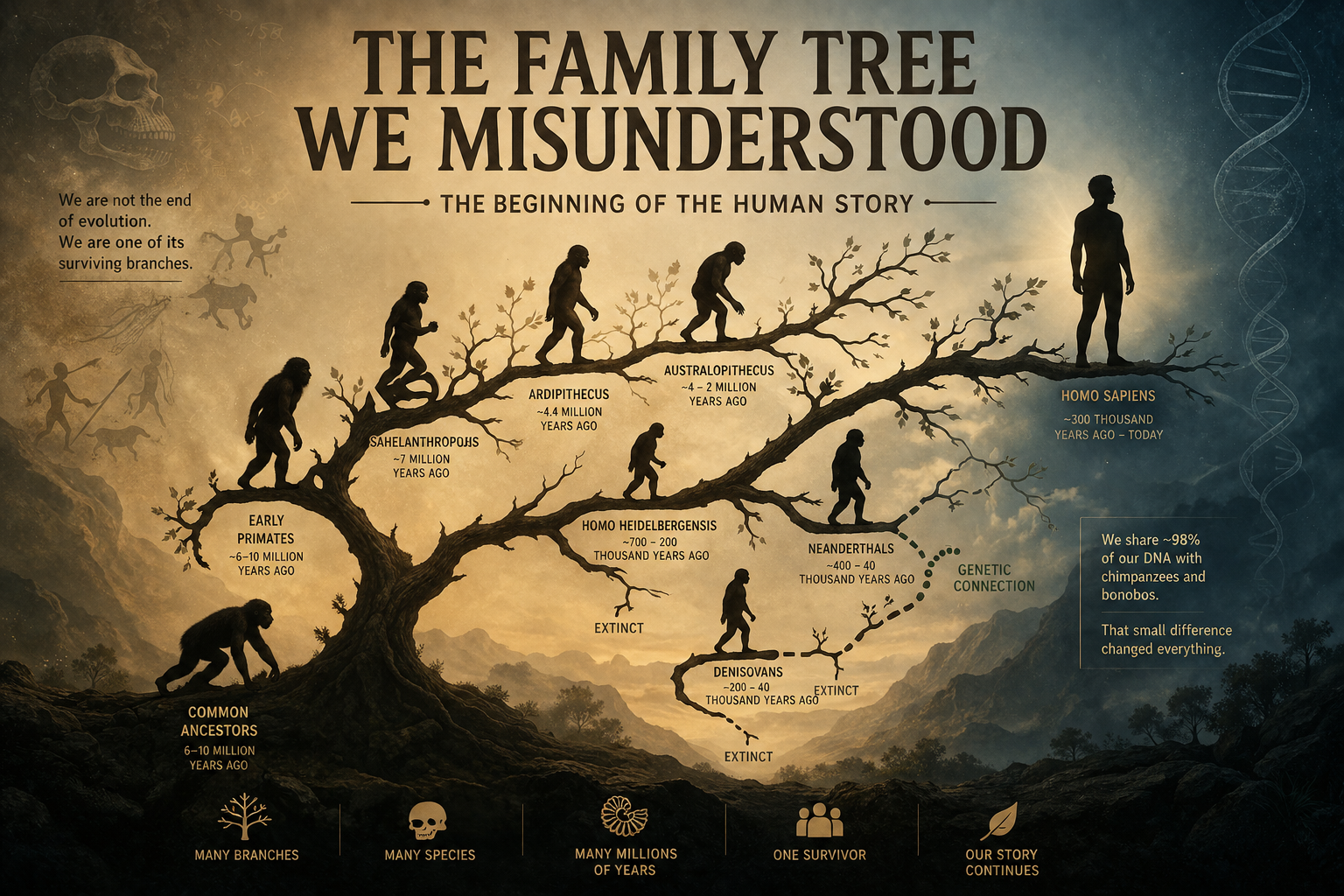
Before we meet the first humans, we need to understand the family tree.
Listen to this story
🪜
The Wrong Picture
Perhaps the most common picture of human evolution is also the wrong one.
A monkey stands at one end. Then comes an ape. Then a series of increasingly upright creatures. And finally, at the end of the line, stands us.
Homo sapiens.
It is a neat picture. It is also not how evolution works.
🐒
Not Our Ancestor
Humans did not evolve from the monkeys or chimpanzees we see around us today. We share ancient ancestors with them — but those ancestors lived millions of years ago. Since then, our line and theirs have followed different evolutionary paths.
The chimpanzee is not our ancestor. It is our evolutionary relative.
And yet, the genetic connection between us is remarkably close. Depending on how scientists compare the genomes, humans and chimpanzees and bonobos share roughly 98% or more of their DNA sequence in the portions that can be directly aligned. But even a small percentage of difference can represent a vast amount of genetic information. The result is not a minor variation of the same species, but two very different evolutionary paths.
🌳
A Tree, Not a Ladder
A better image is not a ladder, but a tree.
Branches split. Some continue. Some end. Some exist alongside one another for long periods. And sometimes, branches that have separated can meet again.
The human branch itself was once far larger than it is today.
🦴
Many Branches
Over millions of years, different species of early humans appeared. Some walked upright. Some made tools. Some spread across unfamiliar landscapes. Some lived at the same time as other human species.
There were Neanderthals. There were Denisovans. There were many others whose names are now known mainly from fragments of bone, stone tools, and traces left behind in the earth.
🧬
Branches That Met
And the branches did not always remain completely separate.
When some ancestors of modern Homo sapiens encountered Neanderthals, they sometimes had children together. As a result, many people alive today carry small amounts of Neanderthal ancestry — typically around 1–2% among many populations outside Africa, though the exact amount varies. Denisovan ancestry is also present in some modern populations, particularly in parts of Oceania, where it can reach several percent.
So even the extinct branches of the human family have not entirely disappeared. Parts of them are still alive — in us.
🌍
The Only Survivor
The exact shape of the human family tree is still being refined. The fossil record is incomplete, and scientists continue to debate how some species were related. But one thing is clear: human evolution was not a straight line leading inevitably towards us. It was a branching experiment with many different outcomes.
Today, Homo sapiens is the only surviving human species. That fact can quietly distort our understanding of evolution.
🎯
No Destination
We tend to look backwards from the present and imagine that everything was moving towards us — as though we were the destination. But evolution does not work towards a destination.
No species is born with the knowledge that it will become the future. For millions of years, different human species lived, adapted, struggled, and disappeared. They were not failed attempts at becoming us. They were living branches of the family tree, shaped by their own environments and their own histories.
🌿
The Branch That Remains
We are simply the branch that remains.
And perhaps that is the first psychological lesson of our journey. The human mind is very good at looking backwards and finding a straight path to the present. We see ourselves at the end of the story and imagine that the story must always have been leading here.
But evolution has no final destination. The tree does not grow towards us. We are simply one of its surviving branches.
And to understand the mind we carry today, we must now travel backwards — to a time when there were no humans like us, no cities, no written history, and no Homo sapiens. Only ancient branches. And the long, uncertain beginning of the human story.