
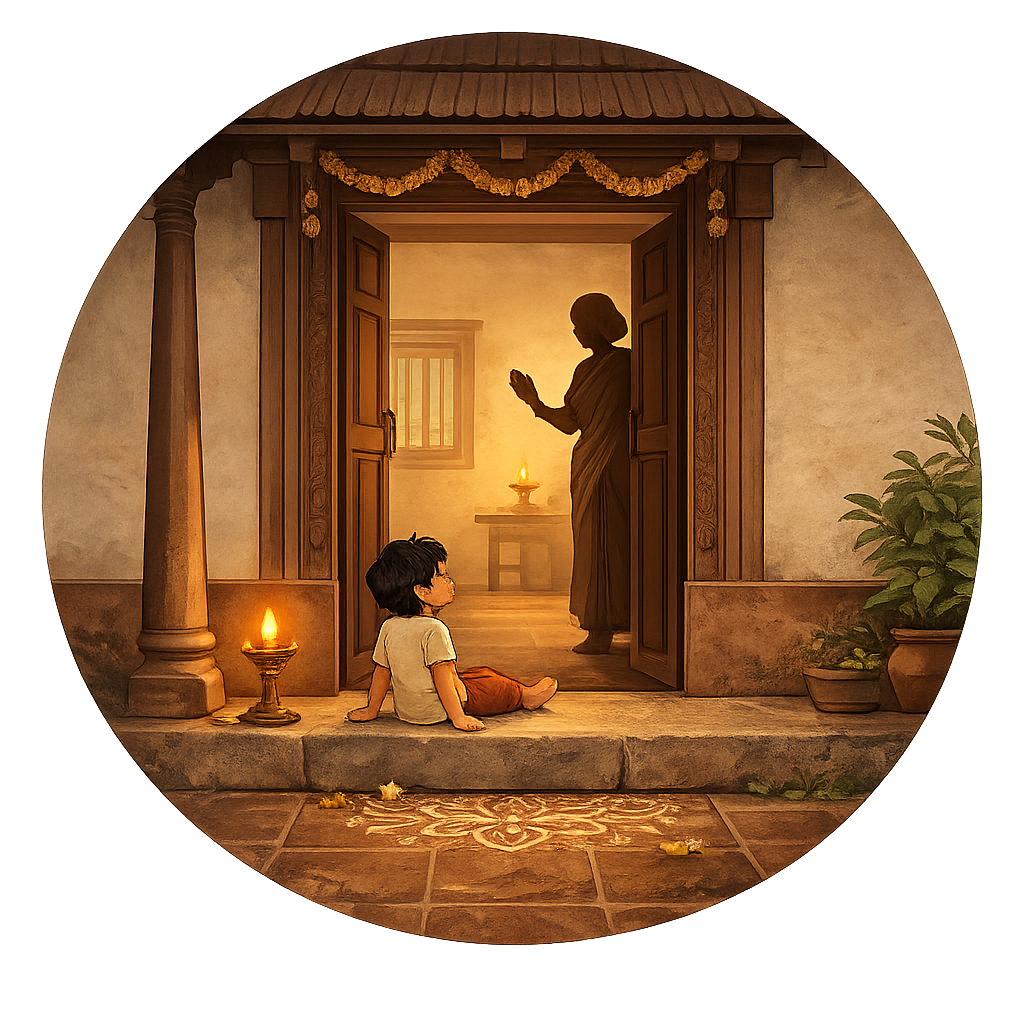
Why Did Our Ancestors Tell Us Never to Sit on the Threshold?
"Get off the doorstep!"
Listen to this story
If you grew up in an Indian home, you've probably heard this more than once.
Maybe you were chatting with a sibling. Maybe you were watching the rain. Maybe you simply found the doorstep a comfortable place to sit.
And then came the familiar warning:
Some families said it would block prosperity. Others warned that Goddess Lakshmi would not enter the house.
To a child, it sounded like just another superstition. But was it?
Walk into a traditional Indian home a century ago, and you'll notice something curious.
The doorway wasn't simply an opening in the wall. It was one of the busiest places in the house.
Family members carried pots of water through it. Farmers brought in harvests and firewood. Guests arrived through it. Children rushed in and out while playing.
Sitting on the threshold wasn't just inconvenient. You were literally sitting in everyone's way.
Instead of repeating, "Move aside!" a hundred times each day, our ancestors created a rule that no one would easily ignore.
But practicality was only part of the story. The threshold also held a special place in Indian culture.
It marked the point where the outside world ended and the home began.
It was where guests were welcomed. Where lamps were lit during festivals. Where beautiful rangoli or kolam designs greeted visitors each morning.
It wasn't just another stone on the floor. It symbolized the transition between public and private, between the ordinary world and the sanctity of home.
Treating it with respect became part of everyday life.
Interestingly, India wasn't alone.
🏛️ Ancient Rome
The threshold was considered so significant that wedding rituals revolved around it. Brides were traditionally carried across the doorway so they would not stumble while entering their new home.
🏯 China
Raised door sills were respected as protective boundaries. People were discouraged from sitting or stepping carelessly on them.
⛩️ Japan
Transitional spaces between the outdoors and the living area are still treated with special etiquette, reflecting the idea that entrances deserve care and respect.
Different civilizations. The same idea. A doorway is never just a doorway.
Modern anthropology even has a word for places like this. They are called liminal spaces.
These are places that mark a transition—from outside to inside, from one stage of life to another, from one world to the next.
Across cultures, people instinctively attach meaning to such places.
Think about it. We celebrate at doorways. We decorate entrances during festivals. We welcome newlyweds at the threshold. We perform housewarming ceremonies before crossing it for the first time.
Even today, we pause before entering certain sacred spaces.
The threshold has always been more than architecture. It is a symbol.
Of course, there were practical reasons too. Old houses often had raised stone thresholds and heavy wooden doors. Someone sitting there could be struck by a swinging door, trip a visitor, or block the path during an emergency.
A simple household rule helped prevent everyday accidents.
So, was the warning really about bad luck?
Perhaps not.
It may have been a beautiful blend of practicality and symbolism. Our ancestors transformed an ordinary architectural feature into a lesson about respect, hospitality, and shared living.
The next time you step over a doorway, pause for a moment. You're not just crossing into a house. You're crossing a space that generations before you considered worthy of care.
Sometimes, the greatest wisdom isn't hidden in grand temples or ancient books.
Sometimes, it's waiting quietly on the doorstep.