
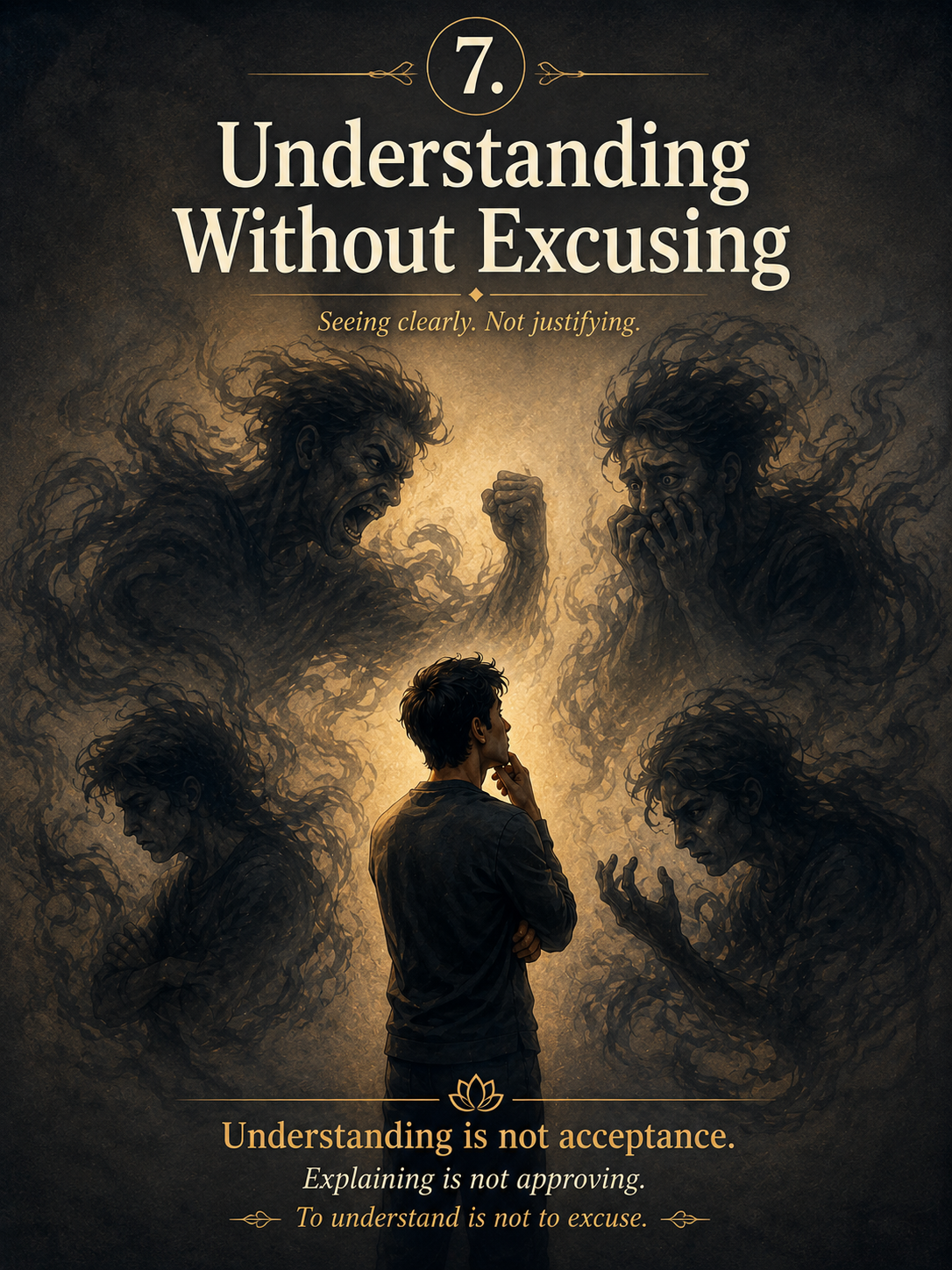
Explaining why emotions exist is not the same as approving every action they inspire. Understanding is not acceptance. Explaining is not approving.
Listen to this story
Imagine watching a storm gather across the horizon. Knowing how storms form does not make them less powerful. It does not mean every storm is harmless. It does not suggest that every path it takes should be accepted.
Understanding simply allows us to see the storm more clearly.
Perhaps our emotional lives deserve the same kind of understanding.
· · ·
Throughout this journey, we have seen that emotions did not appear by accident. They were shaped over immense stretches of evolutionary time. They helped our ancestors survive, form relationships, protect families, cooperate with others, and adapt to changing worlds. Fear, anger, grief, attachment, jealousy, pride, belonging, hope, and countless other emotions all became part of the remarkable inheritance carried by every human being.
Knowing this explains where many emotional impulses come from. It does not decide what happens next.
Evolution often shapes our first impulse. It does not fully determine our final response.
Between those two moments lies the rest of the human story.
· · ·
As societies developed, people began living together under shared customs, expectations, traditions, and laws. Families taught children how emotions could be expressed. Communities developed their own ways of responding to conflict, celebration, loss, responsibility, and forgiveness.
Every society inherited emotional capacities from evolution. Every society also inherited ways of living with those capacities. Some encouraged emotions to be expressed openly. Others valued quiet restraint. Some regarded certain emotions as signs of strength. Others viewed the same emotions differently. The emotional experiences remained recognizably human. Their expression became part of culture.
· · ·
Yet culture, like evolution, does not write the entire story. Each person continues adding to it throughout life. Every experience, every relationship, every disappointment, every act of kindness, every lesson quietly shapes how emotional responses continue to develop.
The emotional brain has many influences.
Evolution writes the first draft.
Culture edits the manuscript.
Each person continues writing their own chapters throughout life.
This helps explain why two people may experience similar emotions and yet respond in very different ways. Their biology may be remarkably similar. Their lives may not be. Understanding these influences can deepen our picture of human behavior.
· · ·
It does not erase responsibility.
To understand why fear exists is not to approve every action taken in fear.
To understand anger is not to celebrate cruelty.
To understand jealousy is not to excuse betrayal.
To understand grief is not to diminish another person's suffering.
Explanation and approval are not the same.
Understanding and acceptance are not the same.
· · ·
Perhaps this distinction has always mattered. Without understanding, we may judge too quickly. Without responsibility, we may explain too much. Humanity has spent countless generations learning to hold both ideas together. To recognize where emotions come from. And to recognize that every emotional impulse becomes part of a larger human story shaped by relationships, communities, choices, and time.
The emotional brain is ancient. Its inheritance is shared by us all. But no emotion, by itself, tells the whole story of a human life.
Perhaps that is one of the quiet achievements of human understanding. Not that we discovered how to eliminate emotion.
But that we gradually learned to distinguish between the feelings that arise within us... and the lives we continue building beyond them. The journey of the emotional brain did not end with understanding. It simply revealed a clearer picture of what it has always meant to be human.