
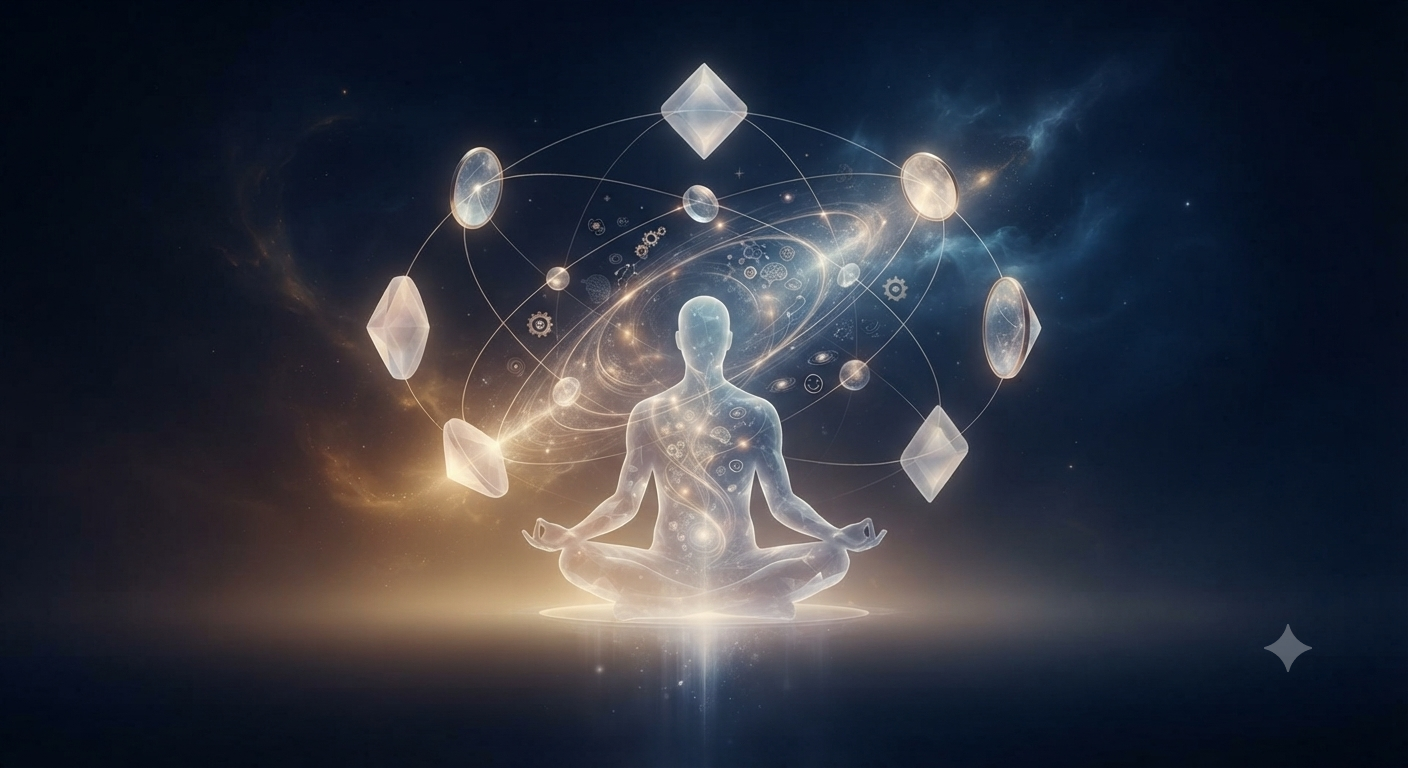
The Mind That Watches Itself
There is a moment when the mind turns around and looks at itself. That moment changes everything.
Listen to this story
There is a moment that most of us have experienced, although we rarely stop to notice how strange it actually is. You are thinking about something. Perhaps you are worried about a conversation, remembering something that happened yesterday, or trying to decide what to do next. Then, suddenly, another thought appears: Why am I thinking about this so much? The subject of your attention has changed. You are no longer simply thinking about the situation. You are watching yourself think about the situation.
For a brief moment, the mind has turned around and looked at itself.
This is not the same as simply having thoughts. Every animal with a sufficiently complex nervous system processes information, learns from experience and changes its behaviour. Humans do this too. But we can sometimes go one step further. We can examine our own thoughts, question our interpretations, notice our emotional reactions and even wonder whether the story we are telling ourselves is accurate.
We can say, I am afraid. Then ask, Why am I afraid? We can think, I know this is true. Then wonder, How do I know? We can become angry and later ask ourselves, What was that anger really about?
The mind has become both the thinker and, in some sense, the thing being observed.
Perhaps this ability did not appear suddenly. A brain that can remember the past can compare what happened with what is happening now. A brain that can imagine the future can compare different possibilities. A brain that can learn from other people can compare its own behaviour with theirs. A brain capable of delaying a response has a little more opportunity to examine what it is about to do.
Over an immense stretch of evolutionary time, these abilities became increasingly interconnected. Eventually, the brain was not only responding to the world. It could begin building a model of itself responding to the world.
And suddenly, many of the things we have taken for granted become more interesting. The two voices we encountered at the beginning are no longer simply arguing. The brain that learned to wait can watch the impulse before acting. The brain that imagined tomorrow can notice the fears it creates about tomorrow. The brain that rehearsed life can recognise that it is rehearsing. The brain that changed its mind can ask why it changed.
The child who learned from other minds can eventually ask which parts of what it learned actually belong to itself. The story has slowly turned inward.
Consider a person who becomes irritated by a harmless remark. The first reaction may be immediate. But later, the person might notice that the reaction was much stronger than the situation seemed to deserve. Perhaps the remark touched an old experience. Perhaps it resembled something heard many times before. Perhaps it carried an association that was invisible in the moment.
The important discovery is not simply what happened. It is the recognition that something happened inside the person while it was happening. The world happens. The mind responds. And then the mind can sometimes observe its own response.
This does not make us perfectly rational. We can misunderstand ourselves. We can invent explanations after the fact. We can become convinced that our interpretation is correct when it isn't. We can watch our own thoughts and still fail to understand where they came from. Self-reflection is not a magical window into truth. It is another ability of the brain — one that can itself make mistakes.
But the possibility of looking again changes something. A reaction no longer has to remain completely invisible to the person experiencing it. A thought can become an object of thought. A belief can become something we examine. An emotion can become something we wonder about.
Culture has also given this ability an enormous vocabulary. For thousands of years, human beings have created stories, conversations, art, literature and philosophy that ask variations of the same strange question: What is happening inside me? Different societies have answered differently. Their explanations have not always agreed. Some have been useful, some less so. But the recurring question itself reveals something remarkable. Humans don't only experience their inner lives. They try to understand them. And then they teach those understandings to other minds.
Today, we have added another layer. We can observe the brain itself. We can study memory, attention, emotion and decision-making. We can examine how different parts of the brain communicate, how experience changes neural connections, and how thoughts and feelings arise from physical processes.
The strange creature that once looked at the stars and wondered about the world has also begun looking inward and asking: what is the machinery inside me that is doing the wondering? That question may be one of the most extraordinary turns in the story of our species.
And yet understanding the brain does not make the human experience disappear. Knowing that fear has evolutionary roots does not make fear meaningless. Knowing that culture shapes us does not make our choices meaningless. Knowing that thoughts arise from a biological system does not make the person experiencing them disappear. The opposite may be closer to the truth. Understanding the machinery can sometimes make the experience less mysterious.
We can recognise that we are animals with ancient systems, living in cultures that teach us, carrying personal histories that shape us, and possessing a brain capable of examining some of the processes that created the person we became.
There is something deeply strange about being able to observe one's own mind. The person who is afraid can notice the fear. The person who is angry can later examine the anger. The person who has made a decision can question the thinking that produced it. Somewhere within all of this, experience and observation begin to overlap. The mind is no longer only receiving the world; it is becoming part of what it observes.
Perhaps this is why human beings can spend so much time asking questions that have no immediate survival value. Why did I react that way? Why do I believe this? Why does this memory still affect me? Why am I afraid of something I know is unlikely to happen? The questions themselves are remarkable. They reveal a mind capable of turning its attention away from the immediate world and directing it toward its own activity.
The ancient animal is still there. It still feels fear, seeks belonging, protects what matters, reacts to threat and reaches for reward. None of that disappeared. But alongside those ancient impulses sits a newer possibility: the ability to notice them, examine them and sometimes choose what happens next.
The result is neither a perfectly rational creature nor a creature free from its evolutionary past. It is something more complicated. An animal carrying millions of years of inherited tendencies, thousands of years of accumulated culture, and a lifetime of personal experience — yet capable, at least sometimes, of looking at all of this and asking what part it has played in making the person it has become.
The brain that once learned to understand the world has acquired another remarkable task. It has begun trying to understand itself. The brain that once learned to understand the world has, over thousands upon thousands of generations, gradually acquired another remarkable capacity: to turn some of that understanding inward.
The human mind has been trying to understand itself for a very long time. And perhaps that is where the deeper form of self-awareness lies — not simply in having a mind, but in becoming curious about the mind we already have.
Across history, that curiosity has taken many forms. People have wondered about consciousness, inner experience, human potential and the possibility of transforming the way the mind works. In different cultures and different periods, some of these explorations became part of philosophical traditions, spiritual practices and religious thought. How far the human mind can be explored, understood and transformed is another story altogether.