
The Journey Continues
Every journey changes the traveller. Not because the world changes. But because the traveller begins to see it differently.
Listen to this story
Every journey changes the traveller.
Not because the world changes.
But because the traveller begins to see it differently.
Our journey began millions of years ago, long before anyone could imagine words like evolution, psychology, or science.
Life faced a simple challenge.
Survive.
Across unimaginable stretches of time, that challenge shaped living organisms into astonishing forms. Eyes learned to detect movement. Ears learned to recognize danger. Minds gradually became better at anticipating the future.
Eventually, one branch of life acquired something extraordinary.
The ability to ask questions about itself.
· · ·
We have followed that remarkable journey.
We watched survival become cooperation.
We saw relationships become as important as physical strength.
We explored emotions that often appear when the mind believes something valuable is under threat.
We discovered that the modern world asks ancient minds to solve problems unlike any our ancestors encountered.
And perhaps most importantly...
We learned that understanding is different from judgment.
· · ·
None of these ideas explain every human experience.
No scientific theory can.
Every person carries a unique story shaped by biology, family, culture, education, relationships, and chance.
Evolution is one chapter in that story.
An important one.
But never the only one.
Science grows stronger by questioning itself, refining old ideas, and remaining open to new evidence. Our understanding of the human mind will continue to evolve, just as humanity itself has evolved.
That is not a weakness of science.
It is one of its greatest strengths.
· · ·
So where does this leave us?
Perhaps with a quieter question than the one we expected.
Not...
"How do I stop feeling fear?"
Nor...
"How do I become fearless?"
But...
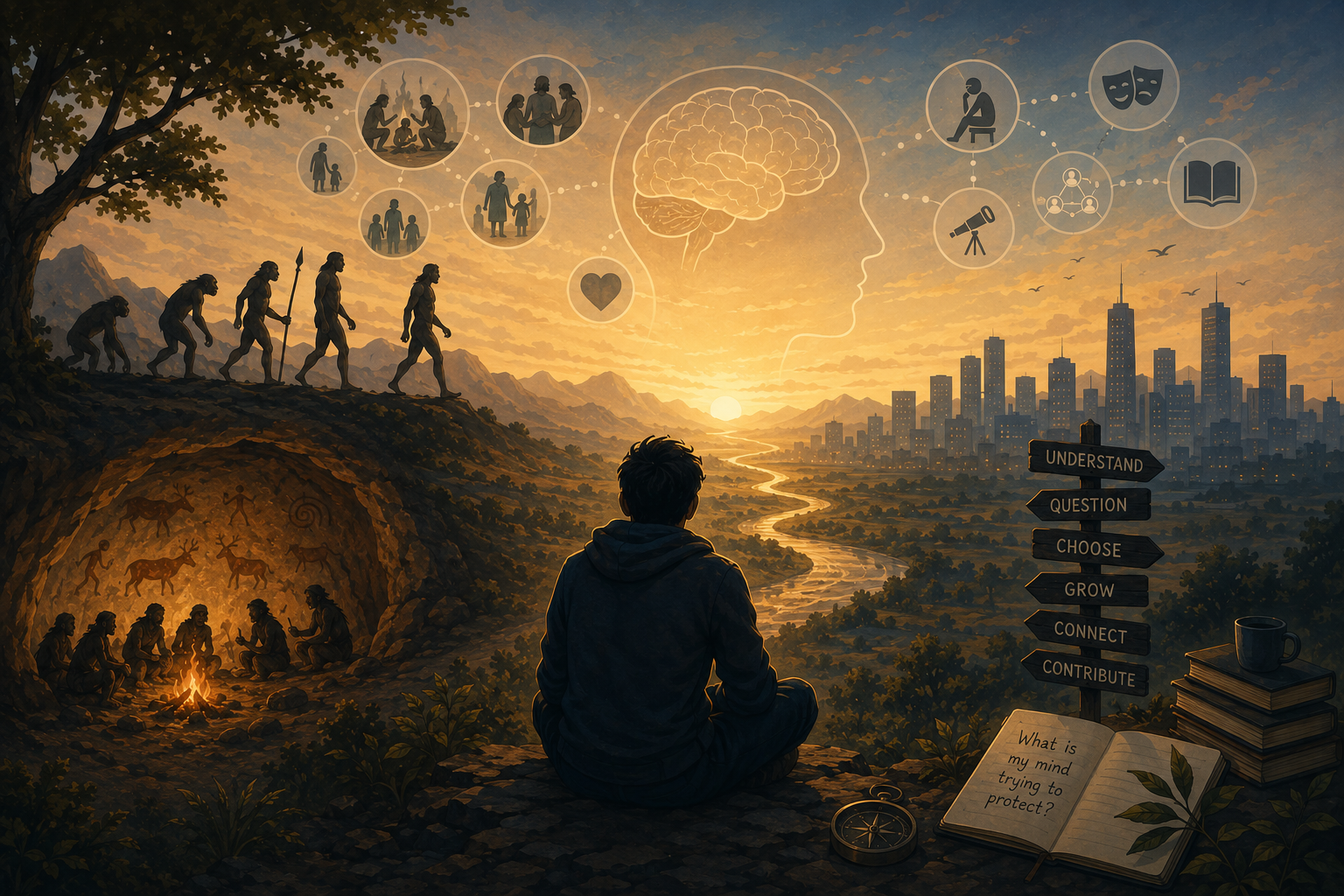
"What is my mind trying to protect?"
Sometimes the answer may be obvious.
A relationship.
A dream.
A reputation.
A child.
A sense of belonging.
Sometimes the answer may be hidden beneath years of experience, memory, or misunderstanding.
Sometimes there may be several answers.
The search itself matters.
· · ·
For much of human history, courage was often imagined as standing before a wild animal, crossing an unknown ocean, or facing an enemy in battle.
Those acts undoubtedly required extraordinary bravery.
Yet modern life asks for another kind of courage.
The courage to question our assumptions.
The courage to admit when we are mistaken.
The courage to listen before reacting.
The courage to understand before judging.
And perhaps the quietest courage of all...
The courage to look within.
· · ·
Looking within does not guarantee pleasant discoveries.
We may find fears we never noticed.
Old wounds we thought had healed.
Beliefs that no longer serve us.
Dreams we quietly abandoned.
But we may also discover something else.
Compassion.
Not the compassion that excuses every action.
The compassion that recognizes every human being carries an ancient mind trying, in its own imperfect way, to protect something that matters.
Understanding another person's behaviour does not always mean agreeing with it.
But understanding often makes wisdom possible.
· · ·
Our ancestors crossed deserts, forests, mountains, and oceans.
They transformed stone into tools. Fire into communities. Language into civilizations. Science into knowledge.
Perhaps the next great frontier is neither geographical nor technological.
Perhaps it is the landscape of the human mind itself.
A landscape we have only just begun to explore.
· · ·
If this series has accomplished anything, I hope it has not been to provide certainty.
Certainty often closes the door to learning.
Curiosity opens it.
So may I leave you with the same question that quietly accompanied us from the beginning?
The next time a powerful emotion visits your mind...
Before judging it...
Before suppressing it...
Before acting upon it...
Pause for just a moment.
And ask,
"What is my mind trying to protect?"
The answer may not arrive immediately.
It may not arrive easily.
But every sincere attempt to understand is, in its own way, an act of courage.
And perhaps that has always been one of the most remarkable things about being human.
Evolution gave us the ability to survive.
Civilization taught us to live together.
Science helps us understand how we came to be.
What we choose to do with that understanding...
is the next chapter in the human story.