
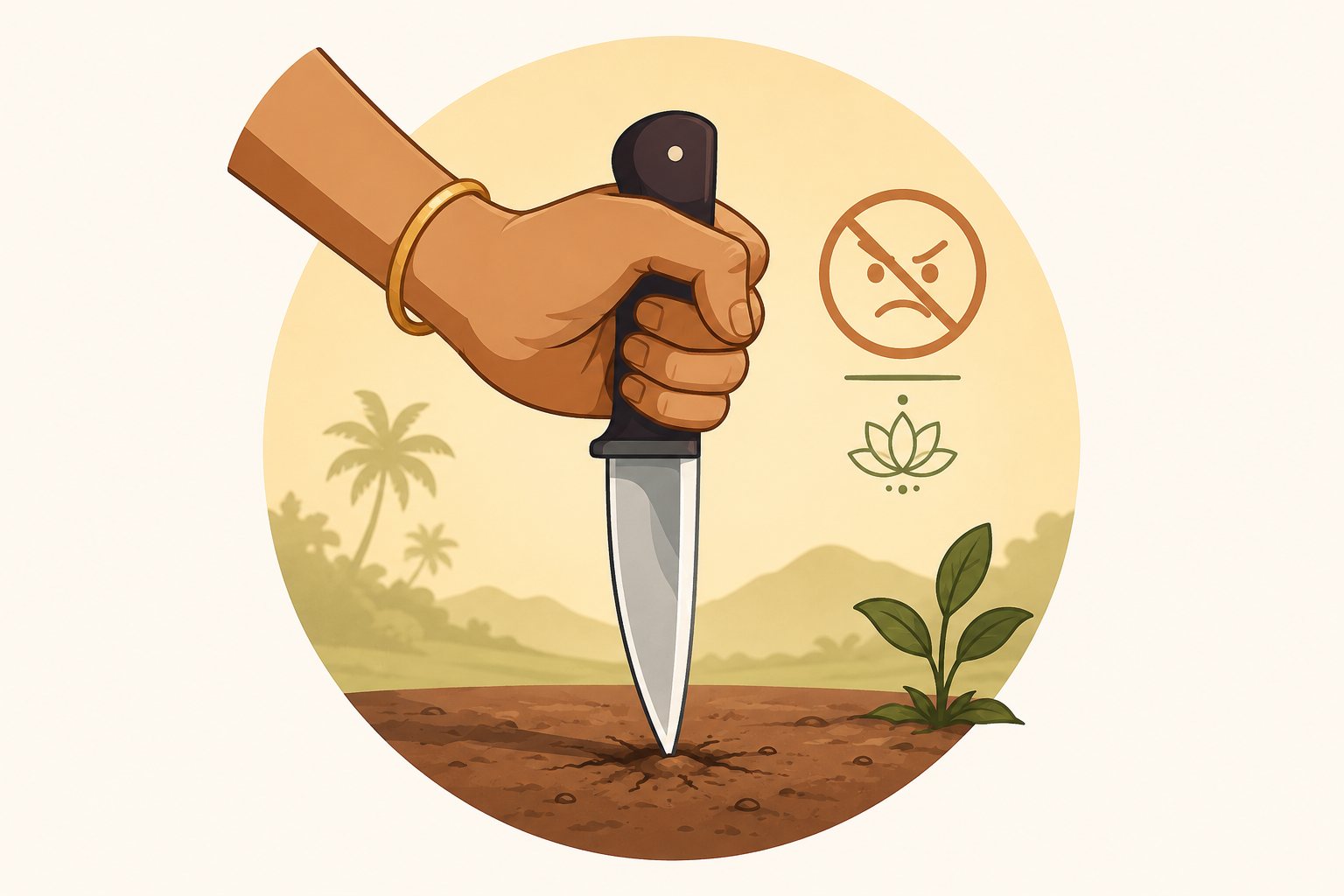
Why Did Our Elders Tell Us to Stab the Ground After Pointing a Knife?
Your grandfather warned you. Kerala folklore insisted on it. Surprisingly, cultures around the world have practiced similar rituals.
Listen to this story
Imagine this scene.
An argument turns heated. Someone grabs a knife in anger.
But before putting it away, an elder stops them.
To many Malayalis, this was more than superstition—it was a rule. But why?
The Kerala Tradition
Across many parts of Kerala, there is a long-standing folk belief:
If a knife, sickle, or sword has been raised or pointed at someone in anger, it should first touch or pierce the ground before being put away.
The act is said to "cool" the weapon and bring the anger to an end.
Although this belief is part of oral tradition rather than classical religious scripture, it has been passed down through generations in farming communities, households, and among people familiar with traditional martial culture.
"The conflict ends here."
The Earth as a Witness
In Indian thought, the Earth is not just soil.
She is Bhumi Devi—patient, enduring, and capable of absorbing what humans cannot.
Touching the blade to the earth symbolically returns anger, pride, and violence to the ground instead of carrying them forward.
The message is simple: The conflict ends here.
Warriors Followed Similar Rituals
Kerala wasn't unique. Throughout history, many warrior cultures developed rituals to "close" an act of violence.
🏯 Japan
Among samurai, a drawn sword was never treated casually. After combat—or even practice—the sword was carefully cleaned, inspected, and returned to its scabbard with deliberate movements. These rituals reinforced discipline and reminded the warrior that a weapon should never remain an extension of anger.
🏰 Medieval Europe
European knights often pointed their swords downward or planted them into the ground after battle or during surrender. The downward-pointing sword became a universal symbol that hostilities had ceased.
🏹 Indigenous Traditions
Several Indigenous cultures across North America and Africa practiced symbolic acts of laying down spears, arrows, or other weapons to signify peace before negotiations. The exact rituals differed, but the idea was remarkably similar: A weapon should not remain "charged" with conflict.
What Psychology Tells Us
Modern psychology offers an interesting perspective.
Rituals help people regulate emotions.
When someone pauses to perform a deliberate action—whether it's taking a deep breath, lighting a candle, or touching a blade to the earth—they interrupt the cycle of anger.
That brief pause gives the rational brain time to catch up with the emotional one.
In today's language, we'd call it a de-escalation ritual. Our ancestors simply expressed it differently.
Was It Ever About Magic?
Perhaps not.
Imagine two people arguing. One reaches for a knife.
Instead of immediately putting it away and walking off still enraged, they are required to perform one final symbolic act.
That ritual signals—to themselves and everyone watching—
Whether the earth truly absorbs anger isn't something science can measure. But the ritual itself may have prevented countless moments of violence.
The Verdict
Was stabbing the ground after pointing a knife just a superstition?
Or was it an ingenious way of teaching emotional control?
Many traditional customs weren't designed as scientific theories. They were designed to shape human behavior.
"Never let anger be the last thing that touches your weapon. Let the earth take it instead."