
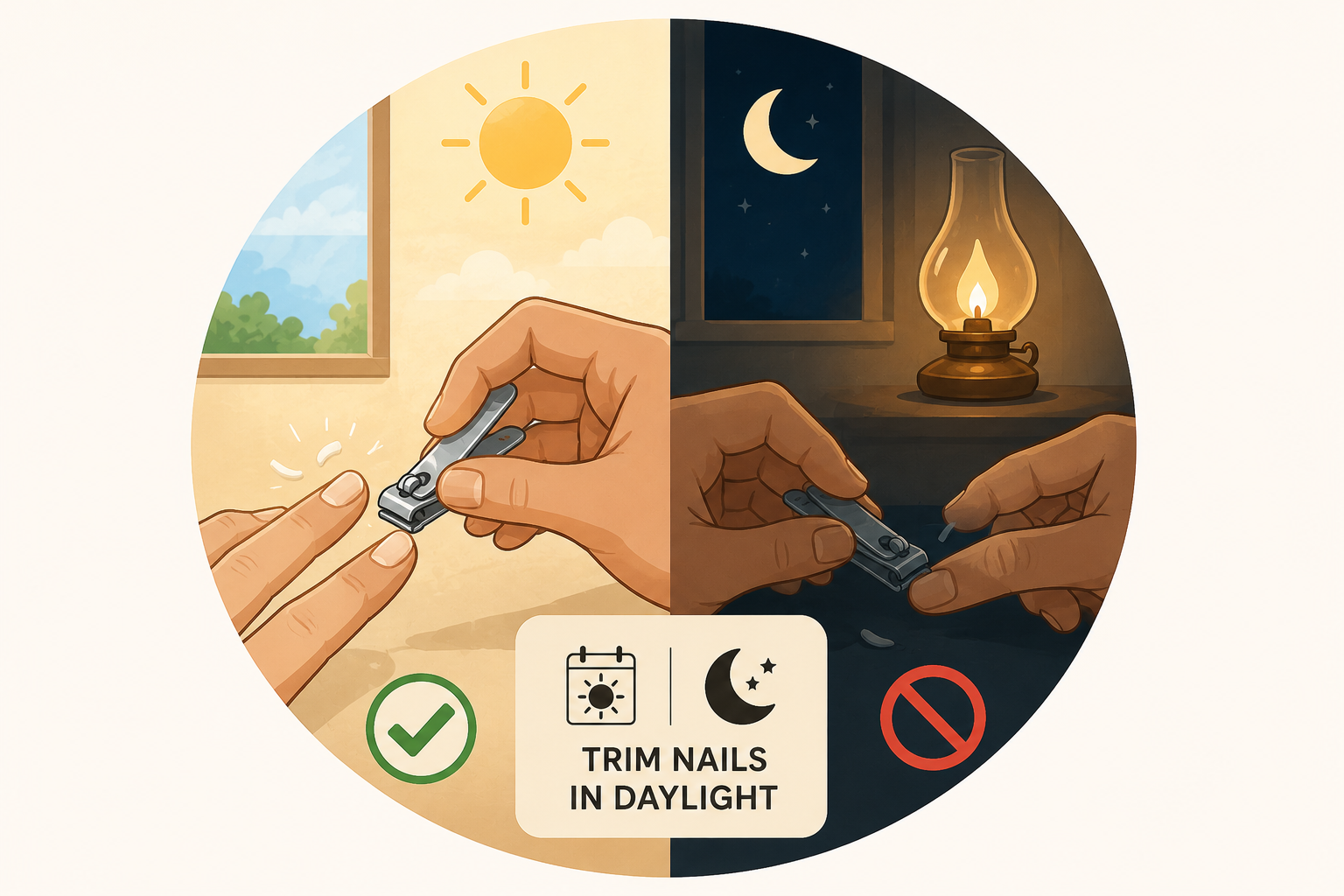
Why Did Our Elders Tell Us Not to Cut Nails After Sunset?
Your grandmother insisted on it. Generations followed it. But was it really superstition?
Listen to this story
If you grew up in an Indian household, you've probably heard it.
"Don't cut your nails after evening."
Some believed it brought bad luck.
Others said it would invite poverty.
Many simply obeyed without ever asking why.
Was it just another old superstition?
Or did it make perfect sense in the world our ancestors lived in?
The Ancient Household Rule
For centuries across India—including Kerala—people avoided cutting their nails after sunset.
The belief appears in many regional traditions, though the explanations vary.
Some associated it with Lakshmi, the goddess of prosperity. Others believed it disturbed household harmony.
But beneath these beliefs may have been a much more practical reason.
Life Before Electricity
Today, trimming your nails takes less than a minute under bright LED lights.
A few hundred years ago, evenings looked very different.
Homes were lit only by
🪔
Oil lamps
•
🕯️
Small wick lamps
•
🕯️
Candles
Their light was dim and flickering.
Cutting nails in such conditions wasn't easy.
People could easily:
- Cut the skin instead of the nail
- Leave sharp edges that caused infections
- Misplace nail clippings inside the house
The safest advice?
Wait until daylight.
Nails Were Harder to Cut
Modern nail clippers are a relatively recent invention.
People once used:
- Small knives
- Scissors
- Razors
- Handmade cutting tools
These required much greater precision.
Poor lighting made accidents far more likely.
A simple household rule protected everyone—especially children.
Cleanliness Mattered
In many traditional homes, floors were swept only once or twice a day.
Tiny nail clippings were difficult to see after sunset.
They could mix with food preparation areas, bedding, or walking spaces.
Discouraging nail cutting at night also helped maintain household cleanliness.
Similar Customs Around the World
India isn't alone.
⛩️ Japan
Traditional Japanese households also discouraged nail cutting at night.
While symbolic, historians believe the custom also emerged when homes relied on dim lamps and sharp cutting tools.
🪶 Korea
Older Korean families similarly discouraged trimming nails after dark. In folklore, nail clippings left around the house were believed to attract misfortune or unwanted spirits.
The stories differed, but every culture arrived at the same practical rule:
Cut your nails during daylight.
What Does Modern Science Say?
Science doesn't suggest that cutting nails after sunset is inherently harmful.
With modern lighting and safe nail clippers, the historical risks are greatly reduced.
However, the original advice wasn't irrational. It reflected the realities of a time when visibility was poor, injuries were harder to treat, and hygiene was more difficult to maintain.
The Verdict
Was your grandmother protecting you from bad luck?
Probably not.
She may have been passing down centuries of practical wisdom—wrapped in stories memorable enough that no one forgot them. Sometimes, what sounds like superstition is simply safety advice that survived long after the reason was forgotten.
Bottom Line
- ✅ There is no scientific evidence that cutting nails after sunset brings bad luck.
- ✅ Historically, the advice made practical sense because of poor lighting, primitive tools, and hygiene concerns.
- ✅ Today, with proper lighting and safe nail clippers, the restriction is largely unnecessary.
The real lesson isn't about nails.
It's about how our ancestors turned everyday safety into traditions that lasted for generations.