
Why Did Our Ancestors Scare Children Into Good Behavior?
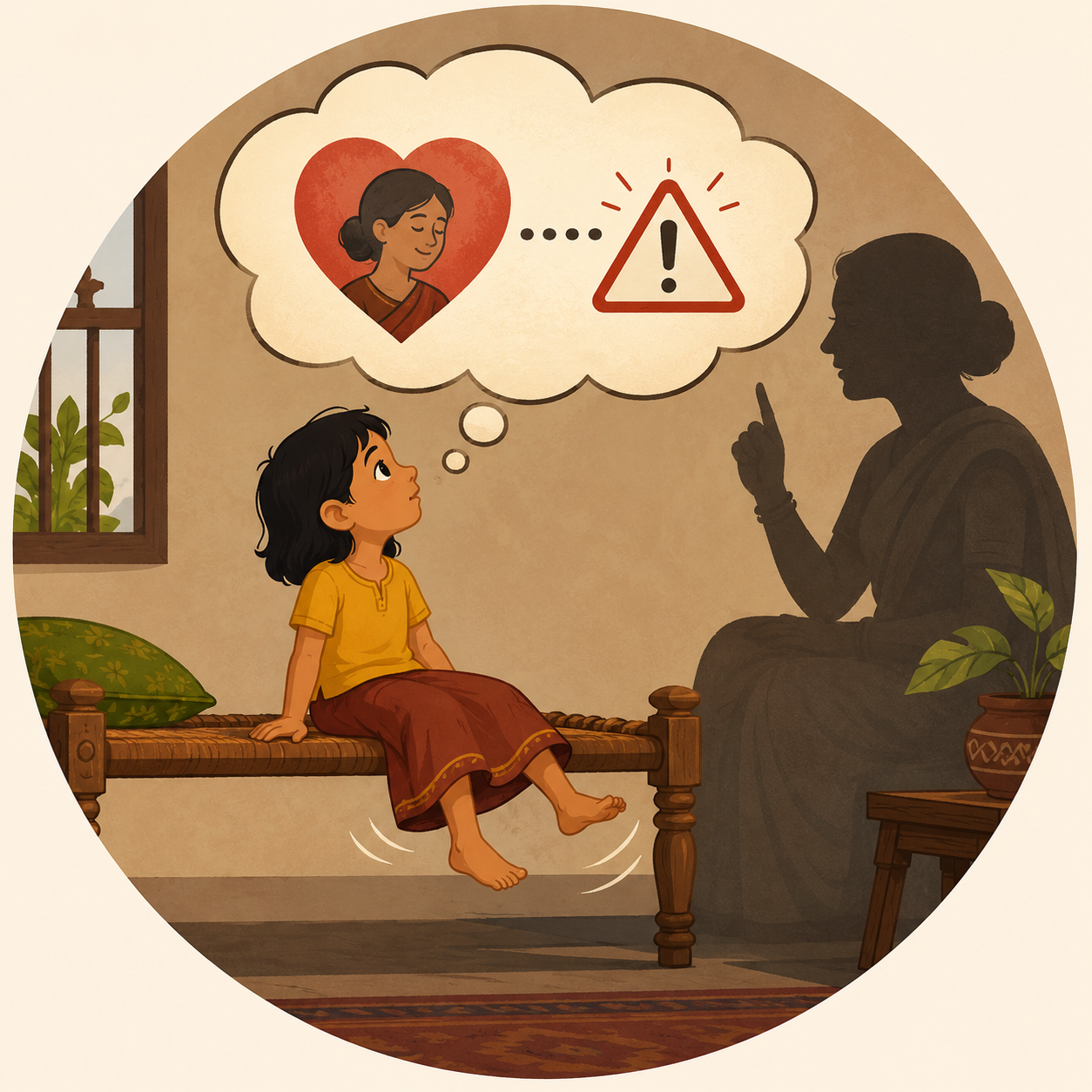
"Don't dangle your legs... or your mother will die."
Listen to this story
It's one of the most unsettling warnings many Indian children grew up hearing.
The punishment seemed strangely unrelated to the crime. What did your mother's life have to do with the way you sat?
As children, we didn't stop to question it. We simply stopped swinging our legs.
Years later, the question still lingers:
Why would generations of parents tell children something so frightening?
Perhaps the answer isn't hidden in superstition.
Perhaps it's hidden in human psychology.
Part One
Imagine raising a child two or three hundred years ago.
There were no parenting books. No child psychologists. No schools teaching emotional development. Parents relied on experience, observation, and stories passed down through generations.
Suppose your child kept sitting on the edge of a high wooden cot, a veranda, or a staircase, happily swinging their legs.
You could repeat, "Sit properly."
You could explain the importance of good posture.
Or you could tell one unforgettable story.
It sounds cruel to modern ears.
But it also has one undeniable quality: a child would never forget it.
Part Two
Long before psychologists studied memory, our ancestors seemed to understand something remarkable.
People remember emotions far better than instructions.
Modern research supports this idea. Experiences tied to strong emotions are generally remembered more vividly than neutral information. A frightening story is far more likely to stay with a child than a calm lecture.
Our ancestors didn't have scientific terminology for emotional learning. They simply knew what worked.
Part Three
Interestingly, this wasn't unique to India.
In China, children were warned that shaking their legs would "shake away their wealth."
In Japan, restless leg shaking came to symbolize poor manners and a lack of self-control.
Across Europe, etiquette manuals discouraged fidgeting and swinging one's legs, teaching children that composed posture reflected good character.
Different cultures invented different stories. But they all seemed to arrive at the same conclusion:
If you want a child to remember a lesson,
wrap it in emotion.
Part Four
The most fascinating part of the Indian warning isn't the dangling legs.
It's the mother.
Why choose such a devastating consequence?
Because nothing mattered more to a young child than the safety of a parent.
By linking an ordinary habit to the person the child loved most, the lesson became unforgettable.
The warning wasn't trying to predict the future. It was trying to shape behavior.
Part Five
Of course, looking at it through today's lens, we also have to ask another question:
Did these stories sometimes work a little too well?
Modern child psychology suggests that while fear can be an effective short-term motivator, repeated fear-based parenting can also have unintended consequences.
Some children may develop unnecessary anxiety, guilt, or irrational fears. Others may struggle to distinguish real dangers from imagined ones. A lesson intended to encourage good behavior can, in some cases, become a source of lasting worry.
This doesn't mean every child who heard such warnings was harmed. Many grew up perfectly well, eventually recognizing these sayings as cultural expressions rather than literal predictions.
But it does remind us that the most memorable lessons are not always the gentlest ones.
Part Six
Parenting itself has evolved.
Today, we are more likely to explain natural consequences than supernatural ones.
Instead of saying,
a parent might simply say,
The goal remains exactly the same.
Only the method has changed.
Perhaps that's the real wisdom hidden inside this old warning.
It wasn't really about dangling legs.
And it certainly wasn't about predicting anyone's death.
It was about understanding something deeply human:
"Stories change behavior more effectively than lectures."
Our ancestors discovered that truth long before science began studying memory, learning, and child development.
Modern psychology agrees with the principle — but also reminds us to use it with care.
Because stories don't just shape habits. They also shape hearts.
Perhaps the challenge for every generation is not whether to tell stories, but what kind of stories we choose to leave behind.