
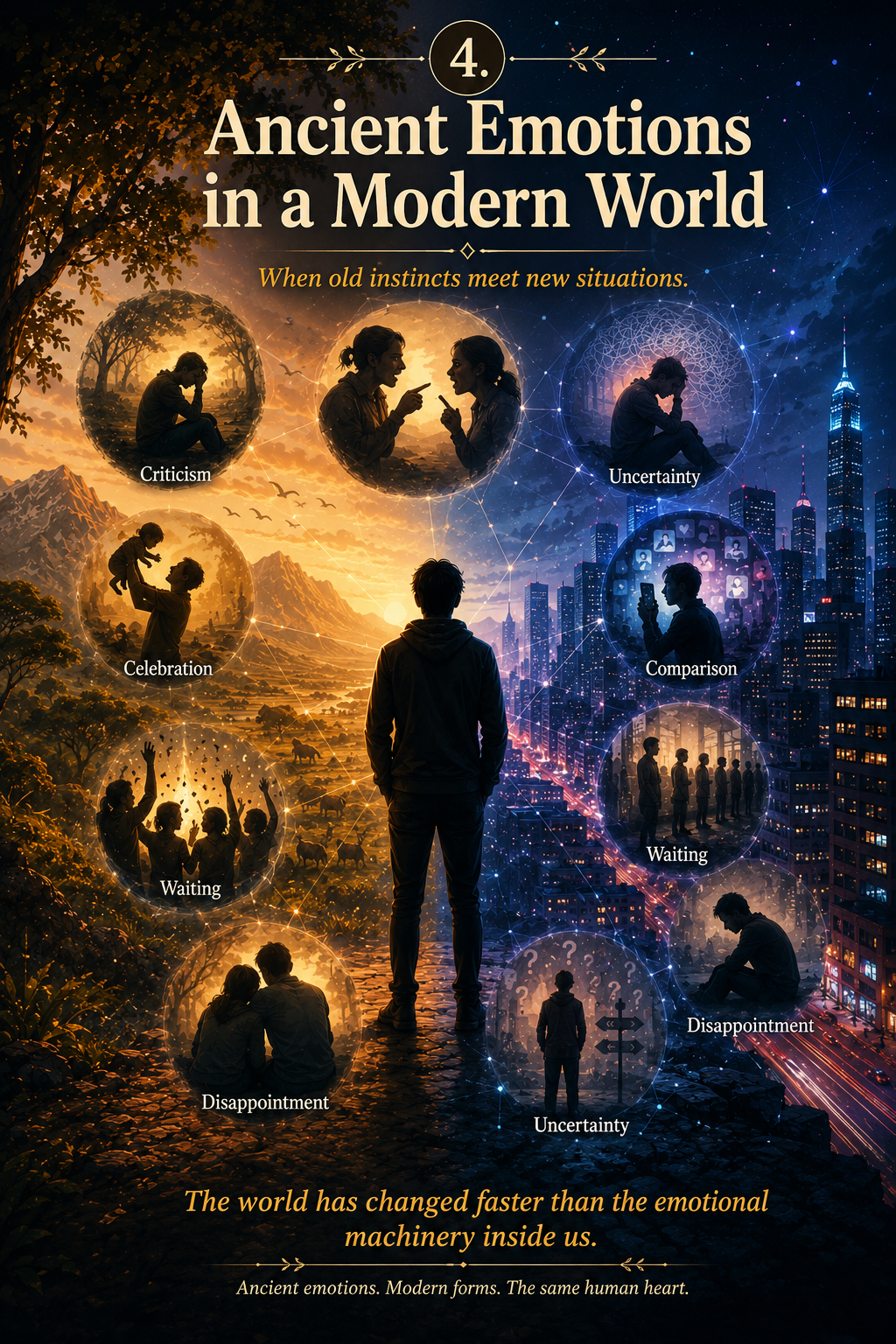
The world has changed beyond recognition. The emotional machinery within us has not.
Listen to this story
A message arrives, but no reply follows.
Someone else's success seems to appear everywhere.
A long wait feels longer than expected.
A few careless words linger in the mind long after the conversation has ended.
A new beginning brings excitement, yet also uncertainty.
A familiar routine suddenly changes.
A quiet disappointment remains difficult to explain.
These moments belong to modern life, yet the emotions they awaken are anything but modern. Although our surroundings have transformed beyond recognition, the emotional machinery within us was shaped over a far longer history.
· · ·
For hundreds of thousands of years, humans lived in small communities where daily life was immediate and deeply personal. The people around us were not names on a screen or faces passing in a crowd. They were family, companions, rivals, caregivers, and neighbours whose presence could influence survival itself.
In such a world, paying close attention to relationships mattered. Being accepted often brought safety. Being rejected could carry real consequences. Uncertainty encouraged caution. Change demanded adaptation. Success strengthened confidence. Failure invited reflection. None of these responses were signs of weakness. They were part of the emotional systems that helped people navigate an unpredictable world.
· · ·
The world around us has changed with extraordinary speed. Cities have grown where forests once stood. Roads connect places that were once separated by mountains and oceans. A thought can travel across the world in moments. We meet more strangers in a single week than many of our ancestors may have met in a lifetime.
Yet the emotional brain remains recognizably ancient.
It still notices criticism more quickly than praise. It still becomes uneasy when outcomes are uncertain. It still compares, anticipates, worries, celebrates, mourns, hopes, and remembers.
The situations are new. The emotional themes are old.
· · ·
This helps explain why relatively ordinary moments can sometimes feel unexpectedly significant. Waiting for an answer may awaken uncertainty. A brief misunderstanding may occupy the mind long after everyone else has forgotten it. A change in circumstances may bring excitement and unease at the same time.
The emotional intensity often surprises us, not because the situation is extraordinary, but because the brain is responding with systems that evolved over immense stretches of time. These are ancient emotional themes appearing in countless modern forms.
· · ·
Each person encounters them differently. A child experiences them while discovering friendships and belonging. An adult may encounter them through changing responsibilities, unexpected setbacks, or new opportunities. An older person may experience them while watching families grow, roles change, and familiar routines gradually disappear.
The circumstances differ. The emotional patterns remain deeply recognizable.
· · ·
Over generations, every society has developed its own ways of understanding and expressing these experiences. Families, communities, traditions, and shared histories all influence how emotions are shown, discussed, or quietly held within.
Yet beneath this remarkable diversity lies something profoundly shared. The uncertainty before important moments. The relief when they pass. The disappointment when hopes are not fulfilled. The quiet satisfaction of being understood. The comfort of belonging. The sadness of parting.
These experiences have accompanied humanity for countless generations. They continue today, not because the modern world has failed to solve them, but because they arise from emotional systems that evolved long before the modern world existed.
Perhaps this is why people across cultures, languages, and centuries have often recognized something of themselves in one another's stories. The details change. The landscapes change. The customs change. But the emotional currents beneath them remain surprisingly familiar.
The emotional brain still carries memories of a world very different from our own.
And slowly, almost without noticing, humanity began asking a new kind of question. Not simply, "Why do I feel this?" but, "What is happening within my own mind?" That quiet question would become one of the most remarkable developments in human history.