
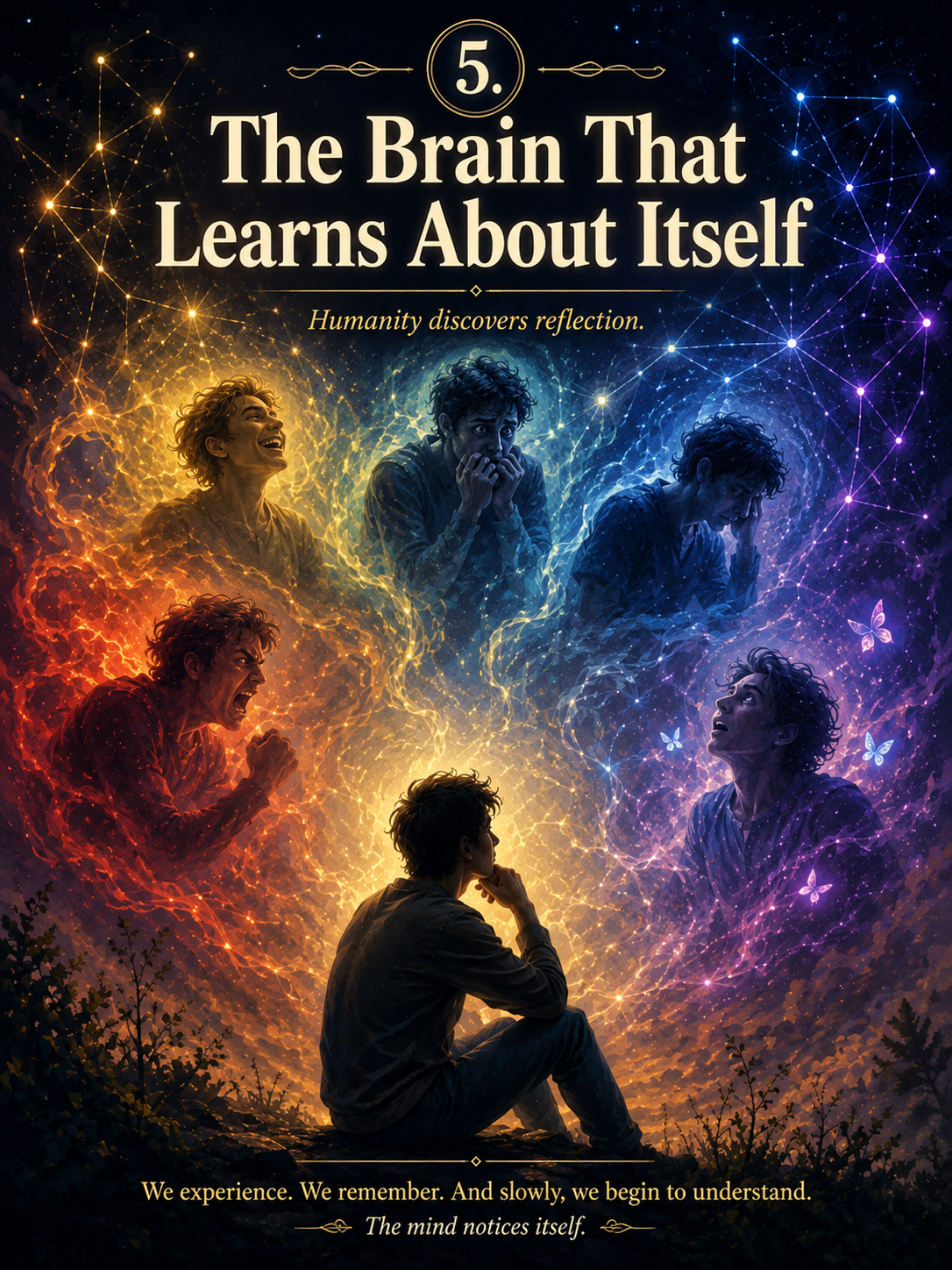
For millions of years, humans simply experienced emotions. Then something remarkable happened: we began noticing ourselves noticing.
Listen to this story
Long before people understood anything about the brain, they understood something about themselves.
They noticed that fear often arrived before danger could be explained. They noticed that joy could appear unexpectedly and quietly fade. They noticed that grief changed with time, that hope returned after disappointment, and that familiar emotions often revisited the human heart in different moments of life.
No one needed to understand neurons to recognize these patterns. They simply lived them.
· · ·
For countless generations, emotions were experienced much as changing weather is experienced today. They arrived, lingered for a while, and eventually gave way to something else. People celebrated, mourned, worried, loved, argued, forgave, and continued living, often without asking why these feelings appeared as they did.
Yet somewhere along humanity's long journey, something remarkable began to happen. People began noticing not only their emotions, but also the fact that they were noticing them.
This quiet shift changed everything.
· · ·
Language gave people words to describe feelings that had once remained unspoken. Stories preserved emotional experiences across generations. Memories allowed people to compare one season of life with another. Conversations revealed that emotions were not experienced by one person alone but were shared, recognized, and understood by others.
The emotional brain had begun looking inward.
· · ·
Across different lands and throughout different periods of history, people spent time reflecting on questions that had no simple answers. Why does loss hurt so deeply? Why does success bring satisfaction that later becomes ordinary? Why do some fears disappear while others remain? Why do the same emotional patterns seem to return throughout life?
These questions appeared in stories, poems, conversations, traditions, and quiet moments of reflection. They belonged to no single civilization and no single generation. Wherever people gathered to share experiences, they gradually discovered that emotional life itself could become an object of curiosity.
· · ·
This growing habit of reflection did not remove emotions. Fear remained. Love remained. Grief remained. Hope remained. What changed was something more subtle.
People slowly realized that emotions could be observed as well as experienced.
This may be one of humanity's most remarkable developments. The same mind that felt joy could later remember it. The same mind that experienced sadness could quietly notice how that sadness changed over time. The same person who once reacted instinctively could begin recognizing familiar emotional patterns returning in different situations.
The emotional brain was becoming aware of itself.
· · ·
Across cultures, this awareness found many forms. Families passed on quiet observations from one generation to the next. Storytellers explored the complexities of human character. Thinkers reflected on the changing nature of happiness and sorrow. Communities developed traditions that helped people make sense of celebration, loss, uncertainty, and hope.
The ideas often differed. The questions remained surprisingly similar. Perhaps this shared curiosity tells us something important about being human. Evolution gave us emotions. Humanity gradually became curious about them.
· · ·
The more people observed their own emotional experiences, the more they noticed recurring patterns. Joy rarely remained unchanged. Fear often arrived before understanding. Loss gradually transformed into memory. Uncertainty invited imagination. Familiar situations awakened familiar feelings.
These patterns appeared so consistently that they became part of humanity's collective understanding of itself. For the first time in the long story of life, a species was not merely responding to the world. It was quietly examining the way it responded.
That discovery did not replace the emotional brain. It expanded it.
And with that expansion came another possibility. If a feeling could be noticed... perhaps it did not always have to decide what happened next.