
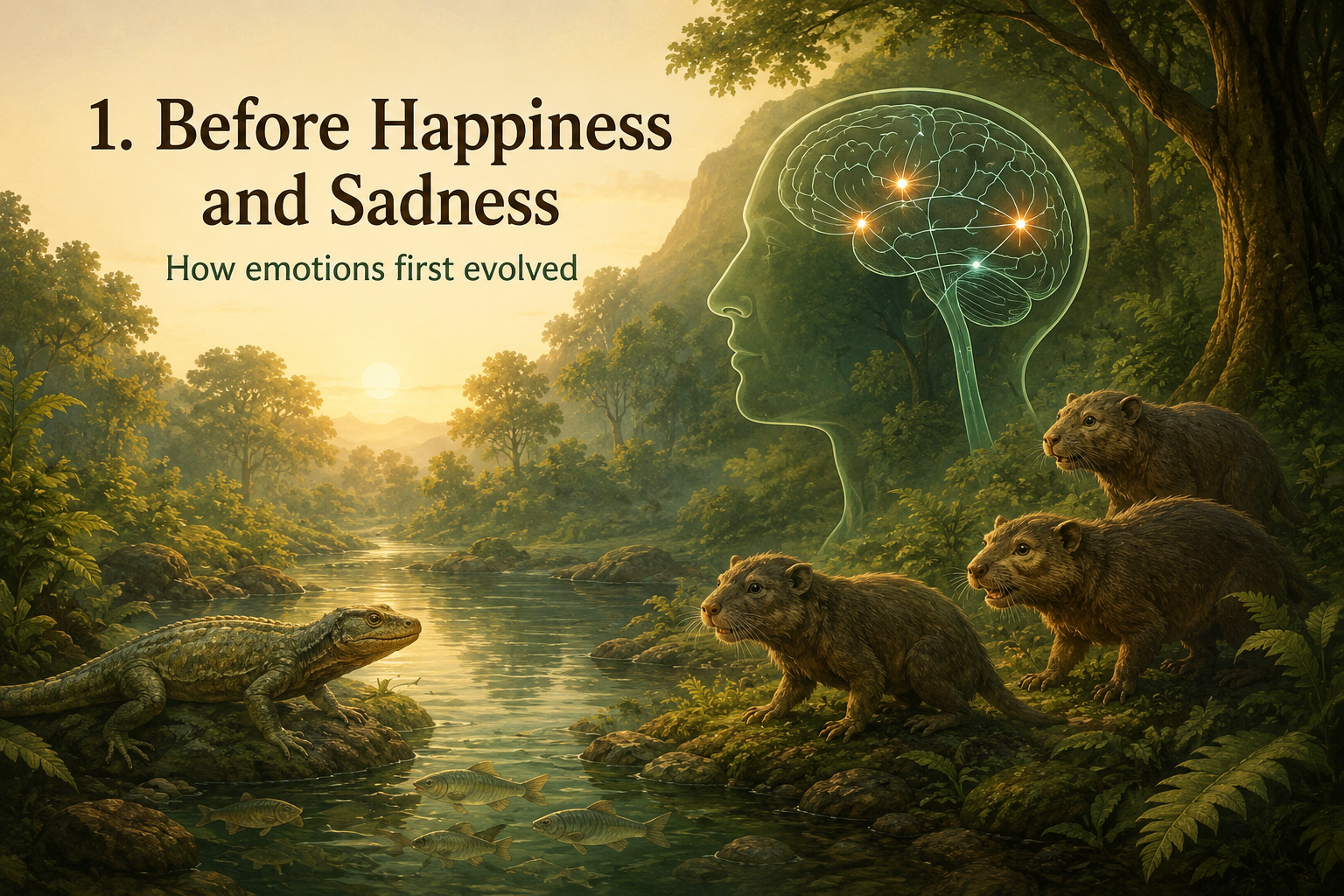
Long before humans felt joy or sorrow, simple organisms developed the first emotional tools: approach and avoid.
Listen to this story
On a quiet morning, a deer pauses at the edge of a forest. It lifts its head, ears alert, sensing something hidden among the trees. After a brief moment, it lowers its head and continues grazing. Thousands of miles away, a child smiles at the sight of a familiar face. Elsewhere, someone receives unexpected news and feels their heart race before a single thought has formed.
Different lives. Different worlds. Yet each begins with a simple truth: something in the environment changes, and something inside responds.
Today, we describe those inner experiences with words such as happiness, sadness, fear, excitement, or love. It is easy to imagine that emotions have always existed in the rich forms we know them. But if we could travel far enough into the past, we would discover a world where none of these feelings existed.
· · ·
The earliest living organisms did not need happiness or sadness. They needed something far more fundamental: ways of responding to a changing world.
A cell drifting toward nutrients was more likely to survive than one that drifted away. An organism that withdrew from harm was more likely to continue living than one that remained still. Over countless generations, nature favored systems that could distinguish opportunity from danger, safety from threat, and nourishment from risk.
At first, these were not emotions as we understand them today. They were simple biological responses — tiny adjustments that quietly improved the chances of survival.
· · ·
As life became more complex, those responses became more sophisticated. Creatures no longer reacted only to what was happening in that instant. They began anticipating, remembering, avoiding, exploring, protecting, and seeking. What had once been simple reactions slowly became internal states that prepared the body for action before conscious thought could ever occur.
Long before humans appeared, evolution had already begun building the foundations of what we now call the emotional brain.
· · ·
None of this happened because nature intended to create happiness. Nor was sadness invented to make life difficult. Evolution does not work toward comfort or fairness. Across immense spans of time, it simply preserved whatever helped living beings leave behind another generation.
The result was not perfection, but possibility.
Some responses encouraged moving toward food, warmth, shelter, or companionship. Others prepared the body to withdraw, defend itself, or remain cautious until danger had passed. These early emotional systems were remarkably practical. They did not ask whether life felt meaningful. They asked only one question: would this response improve the chances of survival?
· · ·
Over millions of years, those ancient systems became increasingly refined. They quietly influenced movement, attention, memory, and decision-making. By the time the first humans walked the Earth, the foundations of emotional life had already been under construction for an unimaginably long time.
Yet something else was beginning to emerge. The world was no longer occupied by solitary creatures responding only to predators and prey. Humans formed families. Children depended on adults for years. Groups hunted together, shared food, protected one another, and remembered those who had been lost. Survival was becoming a shared effort rather than an individual one.
The emotional landscape was about to change. The simple responses that had once helped an individual survive would gradually expand into something far richer — feelings that connected one person to another, strengthened communities, and shaped the lives of generations yet to come.
The story of the emotional brain was only beginning.
For all our modern technology, languages, and civilizations, every human being still carries traces of those first biological responses.
They remain quietly active beneath our thoughts, reminding us that before there was happiness or sadness, there was simply life learning how to respond to the world.