
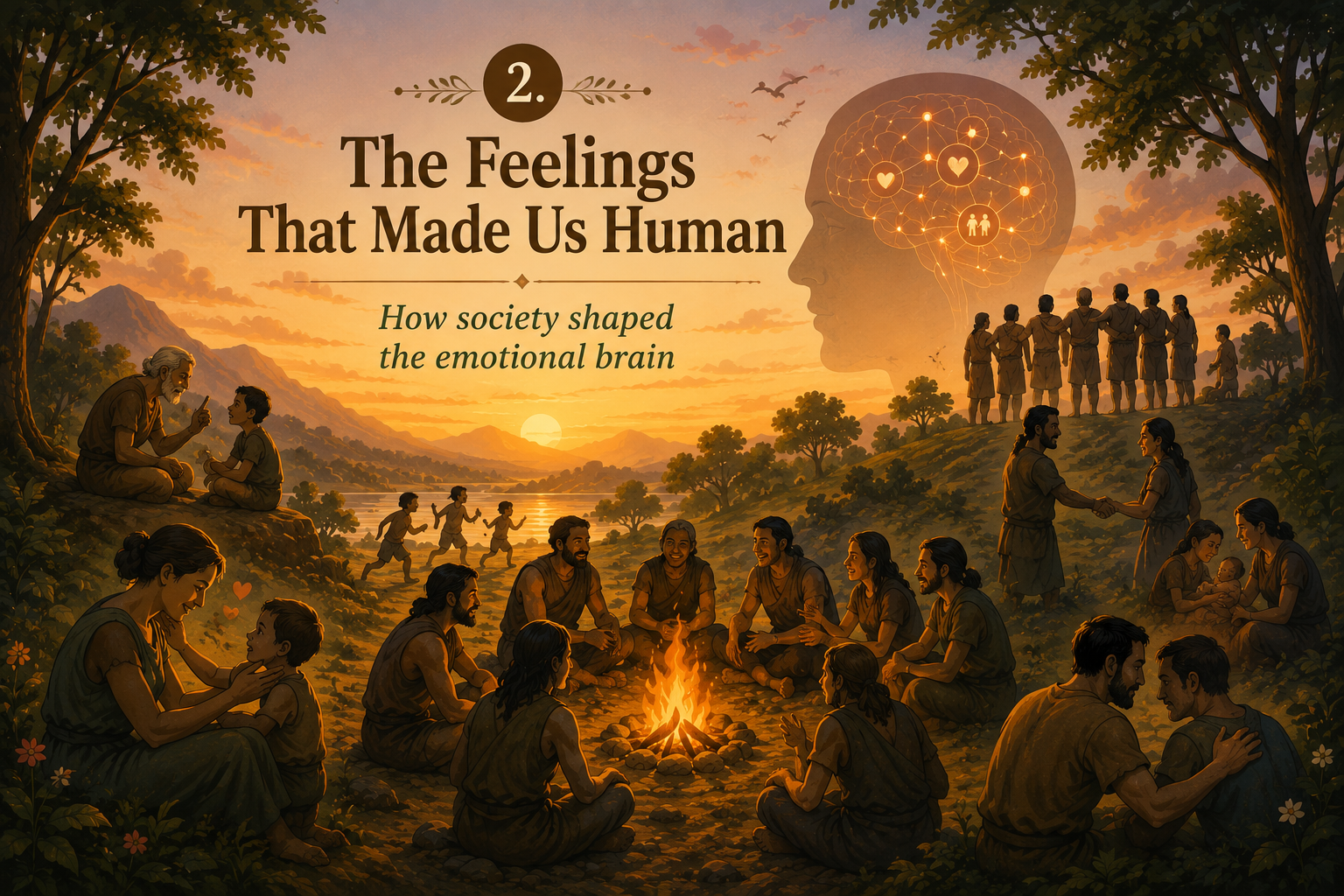
As humans formed families and communities, new emotions emerged. These weren't random — they helped people live together, raise children, and cooperate.
Listen to this story
Imagine meeting another human not as a stranger, but as someone whose survival is tied to your own.
For much of life's history, survival was largely an individual struggle. Finding food, escaping danger, and reproducing depended primarily on the abilities of each organism. But as our ancestors began living in increasingly cooperative groups, something remarkable happened.
The greatest challenge was no longer surviving alone. It was learning to survive together.
Families became larger. Children remained dependent for many years. Food was gathered and shared. Knowledge passed from one generation to the next. Injuries could be survived because others offered care. Elders carried memories that younger members had not yet lived. The success of one individual became closely linked to the well-being of many others.
The emotional brain quietly adapted to this new way of life. The ancient responses that once helped an individual avoid danger gradually expanded into emotions that helped people remain connected.
· · ·
Attachment encouraged parents to care for children long after infancy.
Loneliness gently pulled people back toward their community when they became isolated.
Grief reflected the importance of losing someone whose presence had once mattered.
Pride strengthened reputation within a group.
Embarrassment helped repair damaged relationships.
Guilt encouraged reconciliation after harming others.
Jealousy drew attention to relationships that seemed threatened.
Belonging offered reassurance that one still had a place among others.
These feelings were not separate inventions appearing overnight. They slowly emerged as human lives became increasingly intertwined. As communities grew more complex, so did the emotional systems that helped hold them together.
· · ·
This may explain why many of our strongest emotions involve other people. A harsh word can linger long after a physical wound has healed. A simple act of kindness can remain in memory for years. Being welcomed often brings quiet comfort. Being excluded can feel unexpectedly painful. Although the situations differ from one life to another, the emotional patterns remain remarkably familiar.
Across cultures and throughout history, people have celebrated together, mourned together, argued, forgiven, competed, cooperated, protected one another, and formed lasting bonds. The customs surrounding these experiences vary enormously, yet the emotional capacities beneath them are strikingly similar.
· · ·
Every society gradually develops its own ways of expressing emotion. Some encourage open celebration. Others value quiet restraint. Some teach children to speak emotions freely. Others teach them to reveal feelings more carefully. The biology remains largely shared, while the expression becomes part of a community's history, traditions, and way of life.
The emotional brain, in that sense, has more than one author.
Evolution writes the first draft.
Culture continues the story.
Each generation quietly adds its own pages, passing them to the next through family life, language, customs, and shared experience. This helps explain why people raised in different parts of the world may respond differently to similar situations. The feelings themselves are often familiar, yet the ways they are understood, expressed, or restrained can vary remarkably.
These differences do not mean human emotions are fundamentally different. Rather, they remind us that our emotional lives have always been shaped by both our shared biology and the societies in which we grow.
· · ·
Over countless generations, this partnership between evolution and culture transformed the emotional landscape. What had once been simple systems for survival became the rich social emotions that define much of human experience today. Love, friendship, loyalty, compassion, grief, pride, shame, belonging, and countless other feelings are woven into families, communities, and civilizations.
The emotional brain had become something far more than a survival mechanism. It had become the invisible thread connecting one human life to another.
And yet, for all its richness, it remained an ancient system — still moving, still adapting, and still carrying echoes of the world in which it first evolved.
Those ancient emotions continue to accompany us today. Only the world around them has changed.