
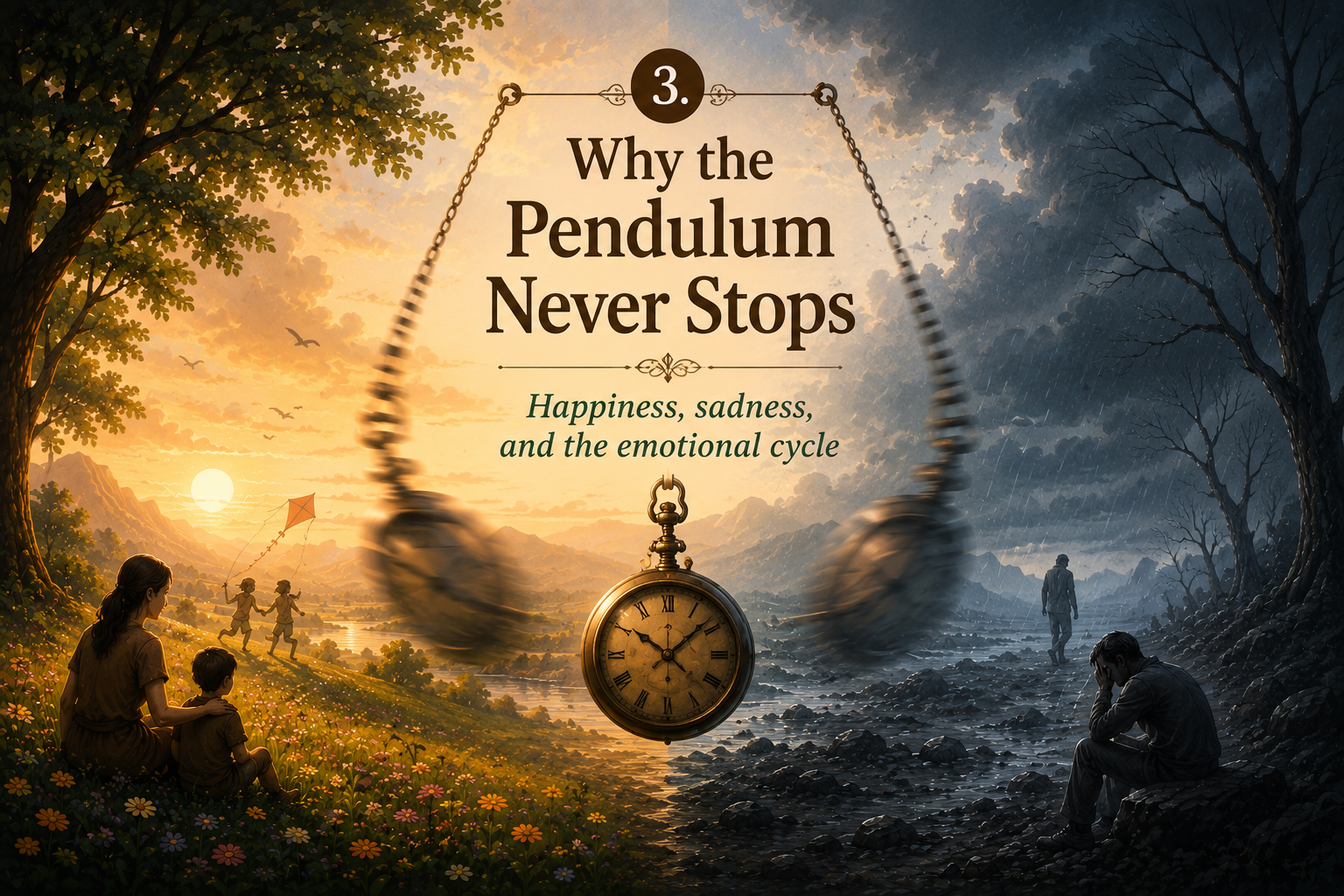
Joy fades. Sorrow softens. The brain keeps moving between emotional states — not because something is broken, but because life itself is always changing.
Listen to this story
There are days when everything seems to fall into place. A long-awaited message arrives. A difficult task finally comes to an end. Friends gather. A child laughs. A quiet evening feels unusually peaceful. For a while, the world appears lighter than it did yesterday.
Yet, after some time, the feeling softens. Life returns to its familiar rhythm.
On other days, disappointment arrives instead. A misunderstanding lingers. Something hoped for never happens. Plans change unexpectedly. Loss, uncertainty, or loneliness quietly settles in.
But these feelings, too, rarely remain unchanged forever. New experiences slowly enter. Time continues moving. The emotional landscape shifts once again.
· · ·
For as long as humans have reflected on their inner lives, they have noticed this gentle rhythm. Happiness does not remain indefinitely. Sadness does not usually remain unchanged either. Our emotional world seems to move continuously, like a pendulum that never truly comes to rest.
It is tempting to imagine this as a flaw. Yet the history of the emotional brain suggests something different.
· · ·
Long before human beings could reflect on joy or sorrow, living creatures benefited from emotional systems that remained sensitive to change.
If satisfaction lasted forever after finding food, there would be little reason to search again.
If fear never eased after danger had passed, ordinary life would become impossible.
If disappointment remained permanently overwhelming, recovery would become increasingly difficult.
Emotional systems that could adjust as circumstances changed were often better suited to a changing world than those that became permanently fixed. Over countless generations, this flexibility became part of the emotional brain itself.
The result is not emotional instability. It is emotional adaptability.
· · ·
The brain continually compares the present with what came before. What was once exciting gradually becomes familiar. What once seemed frightening often becomes manageable. What feels overwhelming today may, with time and changing circumstances, become only a memory.
The pendulum keeps moving not because the brain is confused, but because life itself is constantly changing.
· · ·
This movement can be seen throughout everyday life. A long period of waiting finally ends, and relief quietly replaces uncertainty. A success that once felt extraordinary gradually becomes part of ordinary routine. A painful disappointment slowly makes room for new possibilities. An unfamiliar place eventually begins to feel like home.
The situations differ from one person to another, yet the emotional pattern remains remarkably familiar. These are ancient emotional themes that appear in countless modern forms.
· · ·
Human societies noticed these patterns long before they understood anything about the brain. Across cultures, people observed that seasons change, fortunes change, relationships change, and emotions change with them. Stories, traditions, and reflections from many parts of the world quietly recognized that neither joy nor sorrow remains exactly as it is forever.
These observations were not attempts to eliminate emotion. They were attempts to understand its nature. This understanding gradually became part of humanity's growing awareness of its own emotional life.
The pendulum itself did not disappear. People simply began seeing it more clearly.
· · ·
Even today, our emotional lives continue to move between hope and disappointment, confidence and uncertainty, excitement and familiarity, connection and loneliness. The names of the experiences may change, but the movement itself remains deeply familiar.
Perhaps this is not evidence that something has gone wrong. Perhaps it is one of the oldest characteristics of the emotional brain.
Evolution did not shape emotions to keep us permanently happy or permanently sad. It shaped emotional systems that could respond to an ever-changing world. As the world changed, our inner landscape changed with it.
The pendulum still swings, just as it has for countless generations.
Yet somewhere along humanity's long journey, another possibility slowly began to emerge. People began noticing not only their emotions, but the fact that they were noticing them. The emotional brain was beginning to learn about itself.