
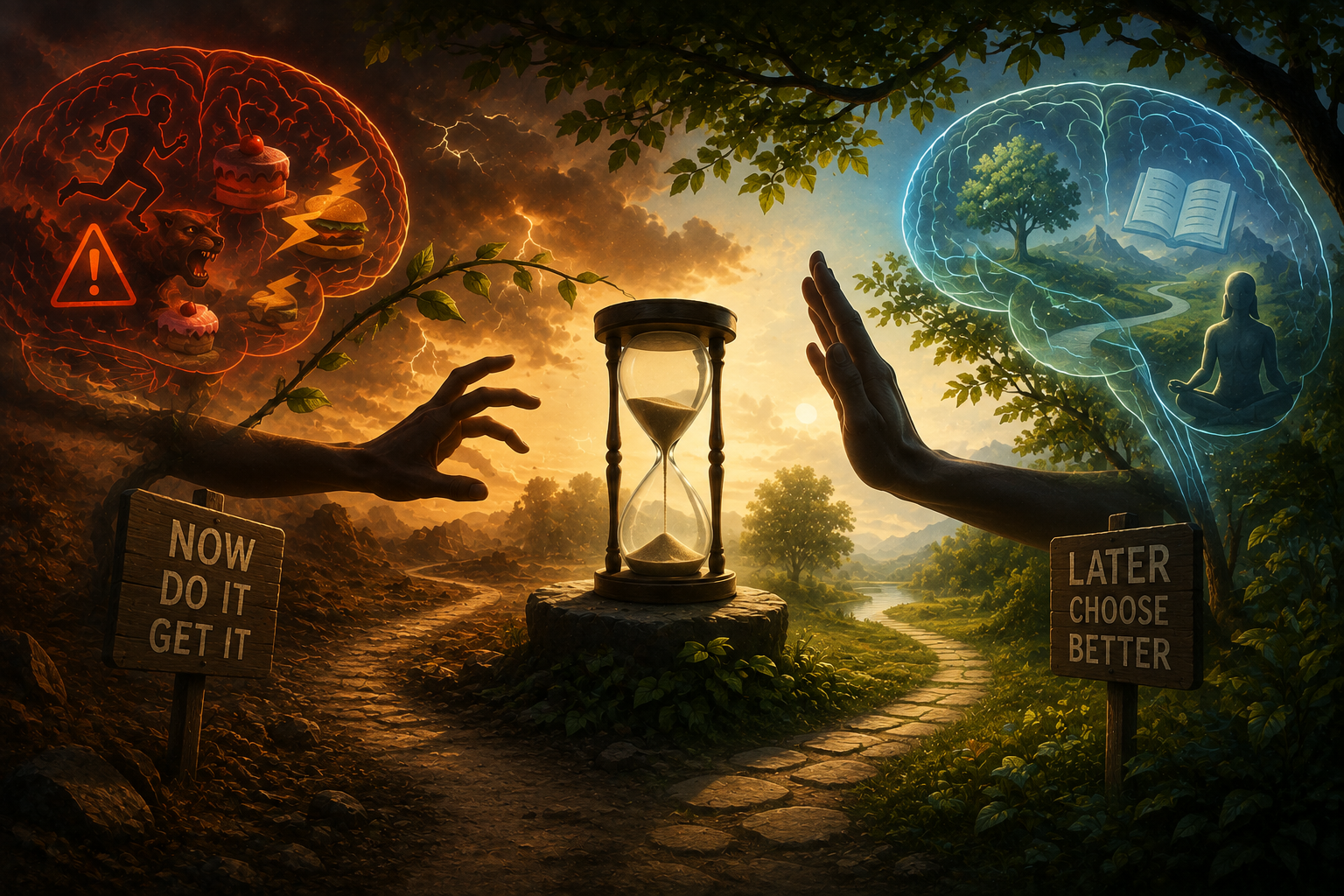
The Ability to Wait
Wanting to do something... and not doing it yet. The small word "wait" may be one of the most remarkable abilities evolution ever gave us.
Listen to this story
There is something strangely difficult about waiting. Not waiting for a train. Not waiting in a queue. Something much simpler. Wanting to do something... and not doing it yet.
You are angry and want to reply. You want to buy something and tell yourself you'll wait until tomorrow. You are hungry, but dinner is almost ready. You want to interrupt someone because you already know what you want to say. You want an answer now. You want certainty now. You want relief now.
And yet, sometimes, something inside you says: Wait. It is such a small word. But perhaps it is one of the most remarkable abilities evolution ever gave us.
Imagine an animal in the wild. Food appears. Eat. Danger appears. Run. An opportunity appears. Take it. A rival approaches. Fight or retreat. For much of the animal world, speed matters enormously. The world changes quickly. The opportunity may disappear. The predator may not wait. The food may be gone. Immediate action can be the difference between survival and failure.
So why would evolution ever favour an animal that could hold back an action that seemed immediately useful?
Because sometimes the first answer is not the best answer.
Imagine an early human finding food. There is enough for tonight. The immediate impulse is obvious: Eat. But what if the person can do something else? Save some. Perhaps tomorrow will be difficult. Perhaps there are children. Perhaps the group has to travel. Perhaps the next opportunity will not come soon.
Suddenly, not eating everything today becomes useful. The present has been sacrificed for a future that does not yet exist. That requires something extraordinary. The brain has to give some importance to tomorrow.
This ability gradually became woven into human life. People began storing food. Preparing tools before they were needed. Building shelters before the weather changed. Planting seeds and waiting months for a harvest. Teaching children skills that would only become useful years later. Saving resources. Making plans. Keeping promises. All of these require a strange willingness to act for a future that cannot yet be seen. The immediate moment is no longer the only thing that matters. The imagined future has entered the decision.
And this is where the story of the prefrontal cortex becomes interesting. The human prefrontal cortex is deeply involved in functions that help us hold information in mind, consider consequences, control responses and keep a future goal in view.
It doesn't simply say: "Don't do it." It helps us ask: "If I do this now, what happens next?" That question sounds ordinary. But it represents a profound change in the way an animal can interact with the world. The future can begin influencing the present.
A child sees something desirable. Now. An adult says: Later. The child is not necessarily wrong. The present reward is real. The adult is not necessarily wiser either. The adult is simply able to include another piece of information: What happens after now? That is the difference. Waiting is not always about discipline. Sometimes it is about seeing beyond the immediate moment.
But there is an interesting complication. The human brain did not evolve in a world of clocks, calendars, online shopping, instant messages and endless choices. It evolved in environments where immediate rewards and immediate dangers could matter enormously. So our minds still respond strongly to what is directly in front of us.
A notification arrives. We look. A message appears. We answer. Something tempting is placed before us. We want it. Someone criticizes us. We want to respond. The ancient attraction of now remains. The newer ability to consider later has to enter the conversation. Sometimes it does. Sometimes it doesn't. And that is perfectly human.
The brain is constantly negotiating between different timescales. There is what I want now. There is what I think I will want later. And there is the difficult question: which one should matter more?
Consider a farmer planting a seed. Nothing happens immediately. The ground looks almost exactly as it did before. Days pass. Weeks pass. The person keeps waiting. The reward exists only as a possibility. Yet human beings became extraordinarily good at this kind of thinking.
We learned to work for things that were invisible. A harvest. A house. A child's education. A journey. A better future. A discovery. A dream. Much of civilization is built on people doing something today for a result that may not arrive for years.
Waiting can look like doing nothing. But sometimes the brain is doing a great deal.
There is another side to this ability, too. The same brain that lets us postpone a reward can postpone worry. We can tell ourselves: Let's see what happens. We can delay an angry response. We can sleep before making a decision. We can leave a question unanswered until we have more information. We can allow uncertainty to remain uncertain.
That may be one of the quietest forms of intelligence the human brain possesses. Not knowing... and not immediately filling the gap.
Perhaps the remarkable thing about waiting is not that we learned to resist ourselves. Perhaps we learned something more useful. We learned that the present does not have to decide everything.
An impulse can arrive without becoming an action. A desire can exist without being immediately satisfied. A fear can appear without determining what happens next. A decision can wait for more information. And somewhere in that small space between wanting and doing, the human mind found another possibility. Choice.
We often celebrate the great achievements of our species. Fire. Tools. Language. Cities. Science. But perhaps some of humanity's greatest achievements began with something much smaller. Someone wanted to act... and waited. Someone could have eaten everything... and saved some for tomorrow. Someone could have answered in anger... and remained silent for a moment. Someone could have given up... and tried once more.
The future, for the first time, was allowed to have a voice in the present. And perhaps that is what the ability to wait really gave us. Not patience. Not discipline. Something larger. A little more time in which another possibility could appear.