
Tomorrow Has Not Happened
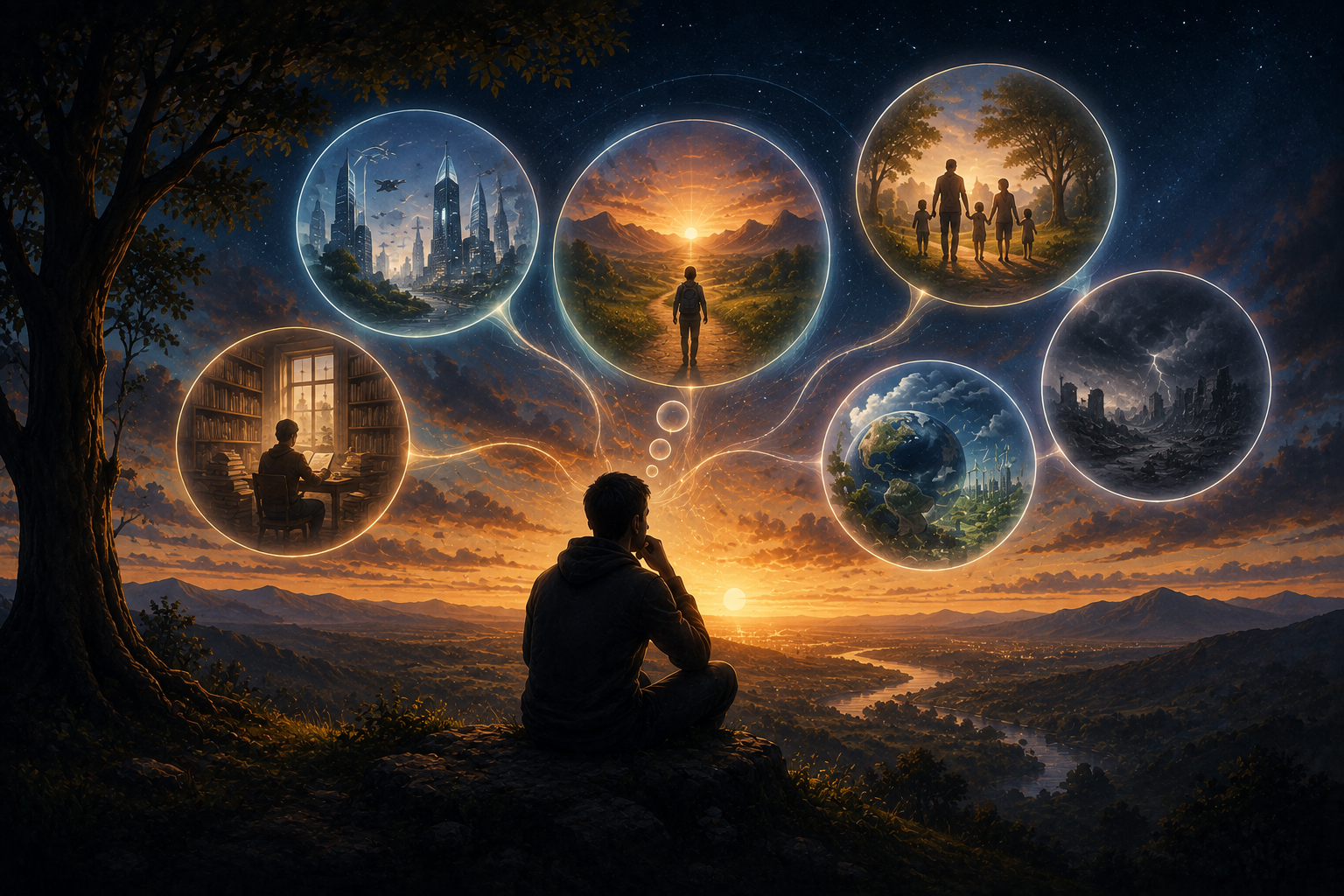
Tomorrow is a strange place. None of us has been there. And yet, we spend an extraordinary amount of time there.
Listen to this story
Tomorrow is a strange place. None of us has been there. And yet, we spend an extraordinary amount of time there.
Before an interview, we imagine how it might go. Before meeting someone, we rehearse what we might say. Before a journey, we picture the road. When something uncertain is approaching, the mind quietly begins asking: What if this happens? What if that happens? Perhaps it will go well. Perhaps it won't.
Tomorrow hasn't happened. Yet our brain is already visiting it.
Perhaps this is one of the most remarkable things about being human. We don't simply remember what happened. We use what happened to construct what might happen.
The brain takes fragments from the past and rearranges them into possibilities. A conversation we once had. A mistake we made. Something our parents told us. Something that happened to a friend. A success. A failure. A story we read. A film we watched. Something we saw online. The mind gathers these pieces and quietly asks: "What could happen next?"
This ability has deep evolutionary roots. Our ancestors also had to anticipate tomorrow. Where will food come from? Will the weather change? Is this place safe? Should we stay or move? A creature that could learn from yesterday and use that information to anticipate tomorrow had an advantage.
But humans pushed this ability much further. We don't simply anticipate what is likely. We imagine what is possible. And possibility can take many forms. Hope. Worry. Planning. Dreaming. Expectation. They may feel very different, but underneath them is the same remarkable ability: imagining something before it happens.
Where does the material for these imagined tomorrows come from? Some of it comes from evolution. But not in the sense that our ancestors' memories are stored in our genes. Evolution gives us the machinery and tendencies that make certain kinds of learning possible. We arrive prepared to notice danger, rewards, faces, voices, relationships and social signals. Then life begins filling that machinery with information. Culture teaches us what is dangerous. What is desirable. What success looks like. What failure means. What people expect from us.
Then comes our own experience. We discover that some people can be trusted. That some risks are worth taking. That some mistakes hurt. That some fears never come true. Our personal history becomes another source from which the brain constructs possible futures.
And today, that library has become enormous. We can watch another person's journey from the other side of the world. See someone else's success. Witness someone else's failure. Read a stranger's experience. Watch a film about a life we have never lived. Scroll through hundreds of versions of what life might look like. We can now borrow pieces of experience from people we have never met.
Our ancestors learned mostly from what they experienced and what their communities could tell them. Our minds now have access to an almost endless collection of other people's experiences. This creates something fascinating. We can become afraid of something that has never happened to us. Hope for something we have never experienced. Prepare for something that has never occurred. Dream about a life that exists nowhere except in imagination. The brain doesn't always need reality itself. It can learn from representations of reality.
But there is an important limitation. The future we imagine is never the future itself. It is a construction. A possibility. Sometimes our minds prepare us brilliantly. Sometimes they frighten us with futures that never arrive. Sometimes we expect disaster and meet an ordinary day. Sometimes we expect an ordinary day and encounter something that changes everything.
Tomorrow continually refuses to behave exactly as we imagined it. And still, the brain keeps imagining.
Perhaps imagining tomorrow isn't really about predicting it perfectly. It is about being less unprepared when it arrives. The farmer imagines the coming season. The parent imagines what a child might need. The builder imagines a structure before constructing it. The scientist imagines an experiment before performing it. The child imagines what it might be like to become something they have never been. Different people. Different centuries. Different cultures. The same extraordinary ability: to let an imagined future influence what we do today.
We sometimes think of imagination as an escape from reality. Perhaps it is also one of the ways we prepare to enter reality. Before a bridge exists, someone has to see it in the mind. Before a journey begins, someone has to imagine arriving. Before something new can be built, somebody has to think: "What if?" That question may be one of the quiet engines of our species.
And yet tomorrow remains what it has always been. Unwritten. Evolution gave us the machinery. Culture gave us stories. Experience gave us memories. The world around us keeps supplying new possibilities. But none of them can tell us exactly what tomorrow will bring.
Tomorrow has not happened. And still, inside the human mind, it has already begun.