
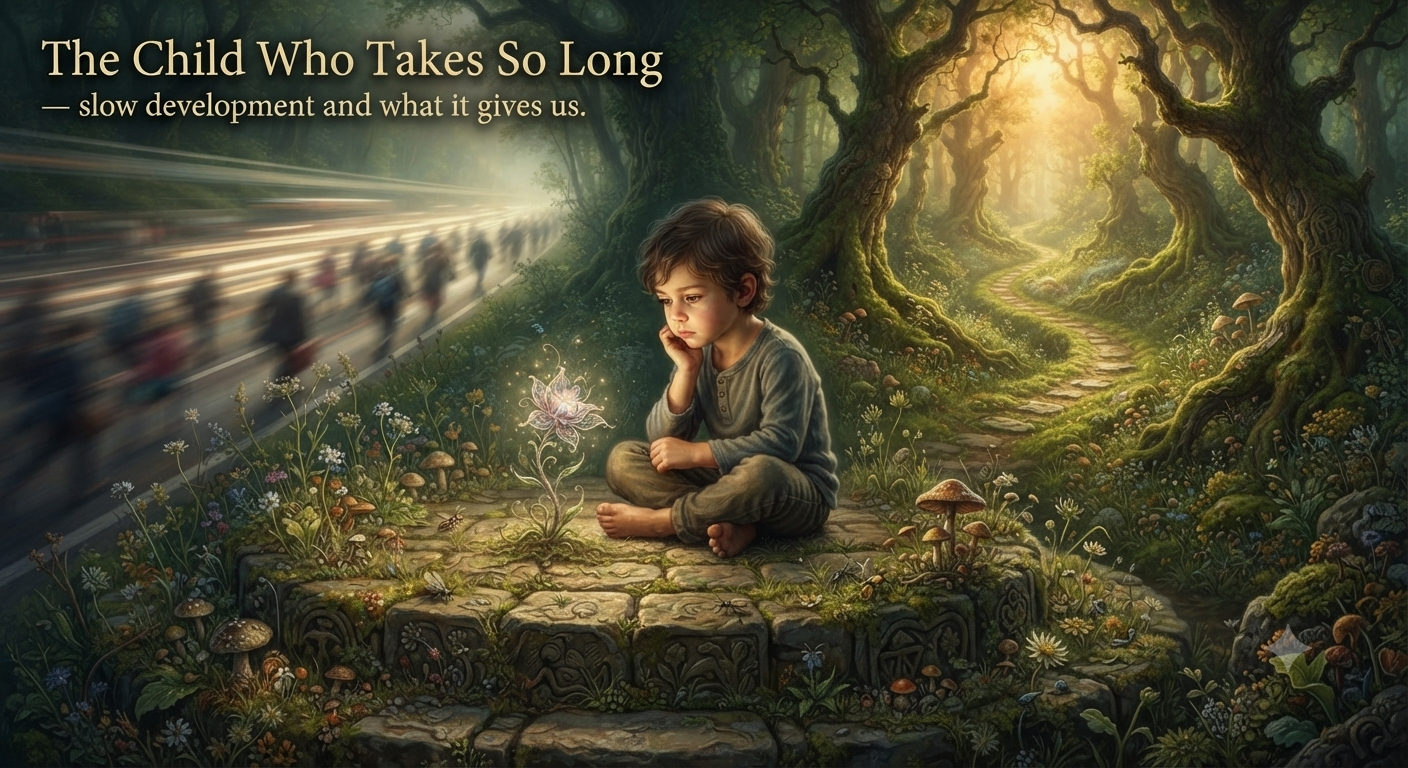
The Child Who Takes So Long
Why would nature produce an animal that takes so long to grow up? Perhaps being unfinished was never the weakness. Perhaps it was the strategy.
Listen to this story
There is something unusual about a human child. We take a very long time to become adults. A young animal can often do surprisingly much on its own. A human child cannot. For years, we depend on others for food, protection, language, learning and almost everything needed to navigate the world.
At first, that seems like a strange evolutionary weakness. Why would nature produce an animal that takes so long to grow up? Perhaps the answer is that a human child isn't simply growing a body. The child is learning a world.
A child has to learn how to read faces, understand voices, use language, recognise danger, cooperate with others, solve problems and make sense of relationships. And the remarkable thing is that the world being learned is not the same everywhere. A child born in one culture may grow up speaking one language, eating particular foods, following particular customs and understanding the world through particular stories. The same human child, born somewhere else, could learn an entirely different way of living.
The biology is remarkably similar. The learned world can be completely different.
That tells us something important about the human brain. It was not designed to arrive with every answer. It was designed with an extraordinary capacity to learn the answers from the world around it.
This ability has deep evolutionary value. Other animals learn too. A young animal watches its mother and learns where to find food, how to move and what to avoid. But human life became unusually complicated. A child doesn't only learn how to survive physically. The child enters a world already built by thousands of generations. Language. Tools. Stories. Skills. Relationships. Knowledge. And now, an enormous digital world. No child could discover all of this alone.
So humans evolved something unusual: a long period of dependence during which the developing brain could absorb an enormous amount from other people.
And the brain itself is changing throughout this period. Connections are being formed, strengthened and reorganised through experience. The child hears a language repeatedly. Sees how people respond to anger. Learns what a particular expression means. Discovers what happens after certain actions. Watches how adults solve problems. Much of this is never formally taught. A child simply watches. The brain learns. The environment becomes part of the developing mind.
There is a remarkable trade-off here. Humans give up early independence. In return, we gain a long period of flexibility. A child can learn to live in a forest, a village, a city, a desert — or eventually, perhaps, in a world none of our ancestors could have imagined. The environment can change dramatically. The child can adapt.
We are born relatively unfinished because the world we enter is too varied to be completely predetermined. Perhaps being unfinished was never the weakness. Perhaps it was the strategy.
And there is another consequence. The people around a child become part of the child's education simply by being themselves. Parents. Grandparents. Siblings. Teachers. Friends. The child learns not only what people say, but what people do. How they respond to fear. How they handle disagreement. How they treat strangers. What they celebrate. What they worry about. What they consider important.
Culture therefore doesn't simply sit around us. During childhood, much of it becomes part of us.
Every adult, then, carries two very different histories. One is ancient — the evolutionary history inherited through biology. The other is personal — the language, people, experiences, stories and culture encountered during a lifetime. The first gives us the capacity. The second helps shape how that capacity is expressed. And the process begins long before we are capable of understanding any of it.
Perhaps that is why human childhood takes so long. We are not merely growing up. We are becoming capable of living in a world that previous generations have spent thousands of years constructing. And once we become adults, the process doesn't completely stop. The brain continues learning. Experience continues changing us. The world continues providing new information. The unfinished child has simply become an unfinished adult.
Perhaps that is one of the quiet secrets of our species. We take so long to become human because being human is not something we are simply born knowing. It is something our brains spend a lifetime learning.