
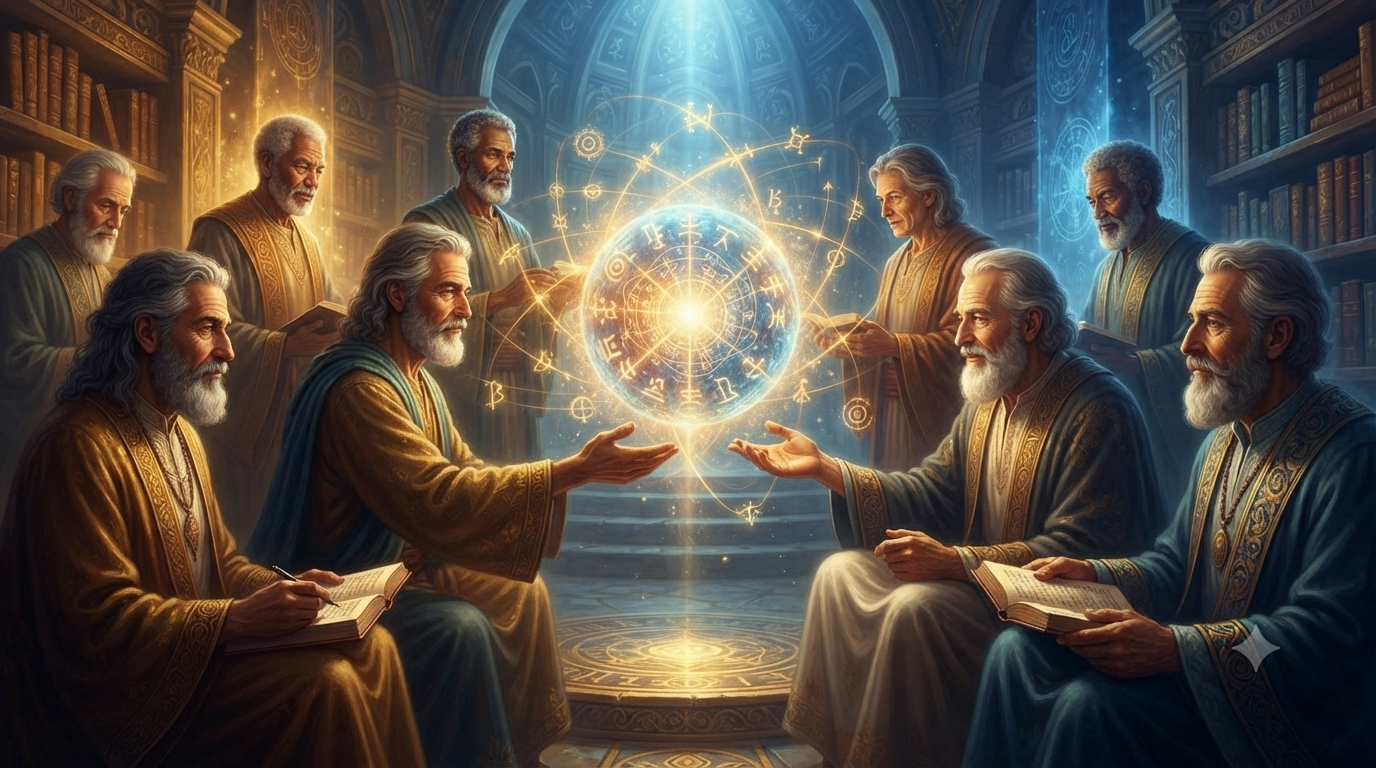
The Mind That Learns From Other Minds
No human starts from the beginning. Someone already knows something. And that changes everything.
Listen to this story
Imagine discovering everything for yourself. How to make fire. How to find food. How to build a shelter. Which plants are useful. Which ones are dangerous. How to make a tool. How to cross a river. How to survive a winter. One lifetime would never be enough.
And yet, no human being starts completely from the beginning. Someone already knows something. We watch. We listen. We imitate. We learn. And then, sometimes, we add something of our own. That simple process may be one of the greatest advantages our species ever acquired.
Other animals learn from one another too. A young animal watches an experienced one. It copies useful behaviour. Humans do this as well. But something unusual happens when human minds begin sharing knowledge. A person discovers something. Another person learns it. A third person changes it. Someone else improves it. Another generation inherits it. The knowledge does not disappear when its original discoverer does. It accumulates.
A stone tool made by one person can become the starting point for another person's improvement. A hunting technique can be remembered. A route can be passed on. A story can carry information across generations. A child learns a word that was spoken by people who lived long before that child was born. Nobody has to reinvent the word. Nobody has to rediscover the technique. Nobody has to begin with an empty mind.
The knowledge of the dead can quietly continue inside the living.
This is where imitation becomes much more than copying. We don't only copy what another person does. We can ask why they do it. We can modify it. Combine it with something else. Teach the modification to another person. And that person can improve it again. A chain begins. One mind leaves something for another. The second mind changes it. The third inherits both the original idea and the improvement.
Over generations, something can emerge that no single human being could have created alone.
Language made this exchange enormously more powerful. A person could describe something that wasn't physically present. Explain an event that had already happened. Warn someone about a danger. Teach a skill. Describe a distant place. Tell a story about something that happened before anyone listening was born.
Knowledge no longer had to remain attached to the person who possessed it. It could travel. From mind to mind. From generation to generation.
And eventually, humans began building external memories too. Marks on stone. Drawings. Symbols. Writing. Books. Maps. Libraries. Photographs. Computers. The human mind found ways to place pieces of its knowledge outside itself. Something discovered by one person could survive long after that person disappeared. A mind could speak to minds it would never meet. A person born centuries later could continue a thought begun by someone they had never known.
Think about what that means. A modern human can wake up and use a language they did not invent, electricity they did not discover, mathematics they did not create, medicine they did not develop and technology they could never have built alone. Much of ordinary life rests on the accumulated work of minds that came before us.
We inherit not only genes. We inherit knowledge.
And unlike genetic inheritance, cultural knowledge can change within a single lifetime. It can be corrected. Expanded. Combined. Rejected. Rebuilt. This may be one reason human beings can change the world so quickly. Biological evolution takes generations. Cultural learning can move much faster. One person discovers something today. Tomorrow, others can know it. Soon, thousands can build upon it.
The brain doesn't have to wait for evolution to redesign it every time the world changes. It can simply learn from another brain.
And perhaps this gives us a different way of looking at civilization. It is not only buildings, machines and institutions. It is also memory shared between minds. Every generation receives a world that contains traces of the thinking of those who came before. Then it decides what to keep. What to change. What to forget. What to add. We are each born into a conversation that began long before us. And, whether we realise it or not, we add a few words of our own.
Perhaps that is the extraordinary thing about the human mind. It does not have to know everything. It has something almost as powerful: the ability to learn from a mind that came before, and leave something behind for a mind that has not yet arrived.