
The Two Voices
There are moments when uncertainty enters our lives — and a conversation begins inside the mind. Who are those two people talking?
Listen to this story
There are moments when uncertainty enters our lives and something strange happens inside us. Nothing has been decided yet. Nothing has actually gone wrong. And yet, inside the mind, a conversation begins.
"This isn't going to work."
"How do you know?"
"Look at what has happened already. It's obvious."
"Perhaps. But we haven't seen what happens next."
"We should prepare for the worst."
"Or perhaps we should wait before deciding what the worst is."
Sometimes the conversation is gentle. Sometimes it becomes almost an argument. One thought becomes anxious, suspicious, impatient, or ready to give up. Another seems to step in with reasons. It remembers what happened before. It considers another possibility. It says, Wait. Let's see. Perhaps there is another explanation.
And then, almost as suddenly as it began, the conversation disappears. The situation settles. Life moves on. And much later, we may suddenly wonder: Who were those two people talking inside my head? There was only one of me. So why did my own mind seem to have two different opinions?
Perhaps the first mistake is to imagine that there really are two people in there. There aren't. But there may be something more interesting happening.
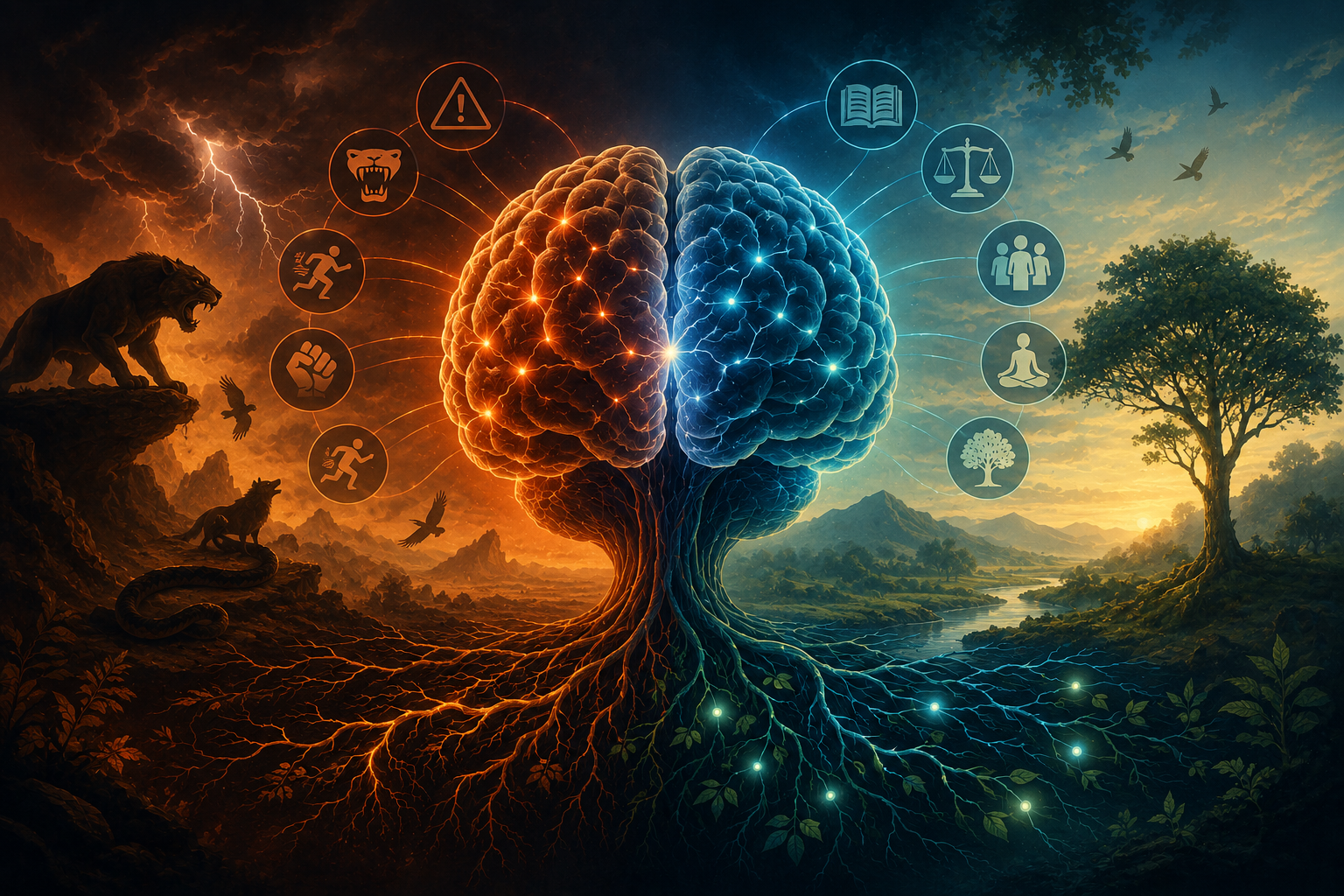
The human brain was not built in one moment. It was assembled across an extraordinarily long evolutionary journey. Some of its systems are ancient. They learned to detect danger, seek food, avoid injury, respond to threats, and react quickly — often before there was time to understand exactly what was happening.
For an animal living in an uncertain world, that was enormously useful. If something moved suddenly in the grass, waiting for an explanation could be dangerous. The safer response might simply be: Move. The brain didn't need certainty. It needed survival.
And much of that ancient machinery remains inside us. We still react to a raised voice. We still feel uneasy when something doesn't look right. We can become defensive before we have understood why. We can feel fear before we have found the reason for it.
The reaction can arrive first. The explanation can come later.
But humans acquired something else along the way. As our brains became more elaborate, so did our ability to remember, compare, imagine, plan and consider consequences. A situation could be examined rather than merely reacted to. A person could think: Have I seen this before? What else could explain it? What happens if I do this? What if I'm wrong?
Among the regions that became especially developed in humans was the prefrontal cortex, situated behind the forehead. It is not the "thinking brain" in the simplistic sense, nor does it operate independently of our emotional systems.
Instead, it participates in a vast network that helps us hold information in mind, consider alternatives, anticipate consequences, regulate responses and make decisions. It gives the brain more room to consider before committing.
And suddenly our strange internal conversation begins to make a little more sense.
Perhaps one part of the brain is reacting to what might happen. Another is asking what could happen. One is drawing attention to the danger. Another is examining the evidence.
One says: "Be careful."
Another asks: "Careful of what?"
Neither is necessarily wrong. The first may have noticed something important before conscious reasoning caught up. The second may prevent us from treating every uncertain situation as a catastrophe.
They are not enemies. They are different parts of a much larger system trying to solve the same problem: What should we do next?
And this is where evolution leaves us with something rather remarkable. The ancient systems did not disappear when newer ones developed. Evolution rarely works by throwing away an old design and starting again. Instead, new abilities were added to old ones.
The quick reaction remained. The slower evaluation grew around it. The memory of the past joined the anticipation of the future. Emotion met reasoning. Experience met imagination. And eventually, all of this began happening inside one brain. Ours.
Perhaps that is why the human mind can sometimes feel contradictory. We are not carrying one perfectly unified machine. We are carrying the accumulated history of evolution.
So the next time two apparently different thoughts seem to argue inside your head, perhaps there is another way of looking at it.
Not: "Why can't I make up my mind?"
But: "What are the different possibilities my brain is trying to evaluate?"
The anxious thought may be protecting you from something. The reassuring thought may be asking you not to assume too much. The impulse may carry useful information. The hesitation may carry useful information too. And somewhere between them, a decision slowly takes shape. We call that decision mine.
And perhaps that is the most extraordinary part of the story. Evolution did not give us a perfectly silent mind. It gave us a mind capable of conversation. A mind in which the past can argue with the future. Emotion can question reason. Fear can meet curiosity. And, sometimes, one thought can stop another long enough for something new to become possible.
Perhaps we don't need to be troubled by the fact that our minds can disagree with themselves. Perhaps we should be curious about it.
After all, somewhere along the evolutionary journey, an animal acquired the extraordinary ability to not only respond to the world — but to have a discussion about what its response should be.