
Ancient Alarms in a Modern World
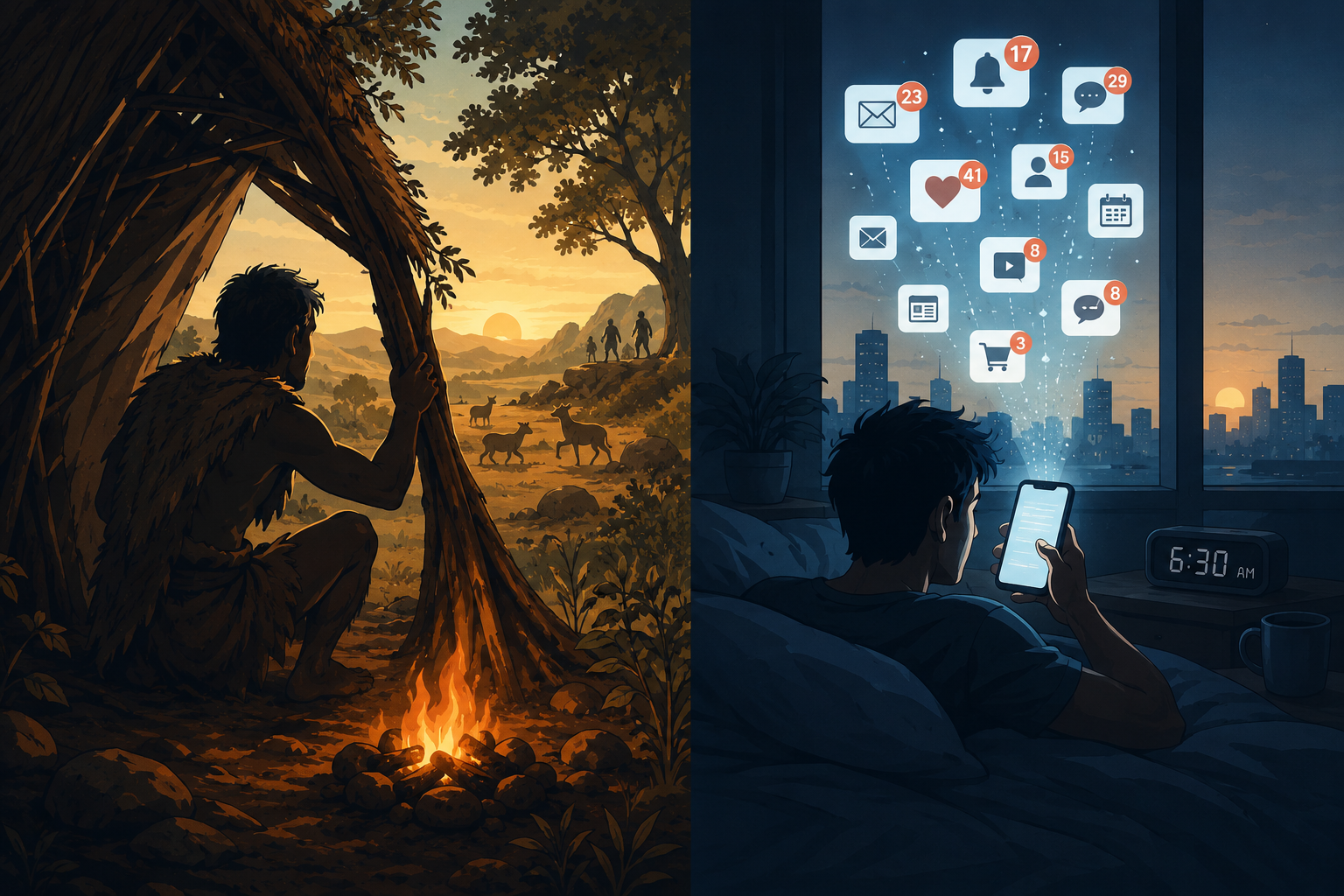
One wakes in a shelter of branches. The other reaches for a phone. Both are doing the same thing.
Listen to this story
On a quiet morning, two humans wake to begin their day.
One opens the flap of a shelter made from branches and animal hide. Before stepping outside, the first instinct is to look across the landscape. Is there movement in the grass? Has another group passed nearby? Did the night's fire keep predators away? Every sound, scent, and shadow carries information.
The other reaches for a mobile phone.
Before even leaving the bed, dozens of notifications appear.
Messages.
News.
Deadlines.
Financial updates.
Social media.
Unread emails.
Neither person is doing anything unusual.
Both are responding to the world they have inherited.
Yet beneath these very different mornings lies a surprising similarity.
Both minds are searching for what might matter next.
· · ·
Evolution does not redesign a species every time its environment changes.
It works gradually, over countless generations.
Agriculture emerged only about twelve thousand years ago—a brief moment compared with the much longer history of our species. Cities, writing, industry, and digital technology are even more recent.
The pace of human innovation has often been much faster than the pace of biological evolution.
As a result, many researchers have proposed what is known as evolutionary mismatch—the idea that traits once well suited to ancestral environments may not always fit the conditions of modern life.
The human mind is often discussed through this lens.
· · ·
Imagine spending your entire life in a small community where you know every face.
News travels slowly.
Resources are limited.
Threats are immediate and usually visible.
Now compare that with modern life.
In a single hour we may encounter opinions from strangers across the world, compare ourselves with hundreds of people online, worry about markets we cannot influence, and read news about events thousands of kilometres away.
The information reaching our minds has changed dramatically.
The biological machinery processing it has changed far less.
· · ·
Consider uncertainty.
For our ancestors, uncertainty often demanded attention.
A changing season could mean hunger.
An unfamiliar sound could mean danger.
Ignoring uncertainty could carry serious consequences.
Today uncertainty wears different clothes.
Will I keep my job?
Will this investment succeed?
Will my child be safe?
Will artificial intelligence change my profession?
Will people approve of what I shared online?
These are real concerns, but they arise in environments our ancestors never experienced.
The ancient habit of scanning for possible threats now has almost unlimited material to examine.
· · ·
Comparison may be another example.
In a small hunter-gatherer group, people naturally compared themselves with those around them.
Who was skilled at making tools?
Who knew the migration routes?
Who could heal an injury?
Such knowledge had practical value.
Today comparison has no obvious limits.
Instead of comparing ourselves with twenty or thirty familiar people, we may compare ourselves with thousands of carefully curated lives displayed through screens.
The comparison system itself is ancient.
Its scale is entirely new.
· · ·
Even success has changed.
For much of human history, obtaining enough food, protecting family, and maintaining trusted relationships were remarkable achievements.
Modern societies have expanded the definition of success into countless measurable goals.
Income.
Followers.
Titles.
Possessions.
Recognition.
The mind often treats these goals seriously because they become connected with belonging, identity, or security.
Whether those connections are realistic or exaggerated varies from person to person.
But the emotional response can feel genuine because the brain is responding to what it perceives as significant.
· · ·
None of this means modern life is harmful.
In many ways, it is safer, healthier, and richer than at any previous time in human history.
Life expectancy has increased.
Medicine has transformed survival.
Knowledge is available to almost anyone.
Human cooperation now extends across continents.
These are extraordinary achievements.
The point is not that the modern world is wrong.
It is that it is remarkably different from the world in which many of our psychological tendencies first evolved.
· · ·
Recognizing this difference can change the way we interpret our own experiences.
Perhaps constant worry is not evidence of a broken mind.
Perhaps endless comparison is not simply a personal weakness.
Perhaps the mind is doing what it has always done—trying to detect risks, anticipate the future, and protect what it believes matters.
That does not mean every alarm is accurate.
It means every alarm deserves to be understood before it is judged.
· · ·
This perspective also offers something hopeful.
If some of our strongest reactions arise because ancient systems are responding to modern situations, then understanding those systems may help us respond more thoughtfully.
Not by ignoring the alarm.
Not by silencing it.
But by asking whether the danger it senses truly exists in the way it imagines.
Sometimes the answer will be yes.
Sometimes it will be no.
Learning the difference may be one of the most valuable skills modern humans can develop.
Our ancestors built a mind that was remarkably good at surviving their world.
We inherited that same mind—
and asked it to navigate a world they could never have imagined.
Perhaps many of the questions we ask about ourselves today begin with understanding that remarkable inheritance.