
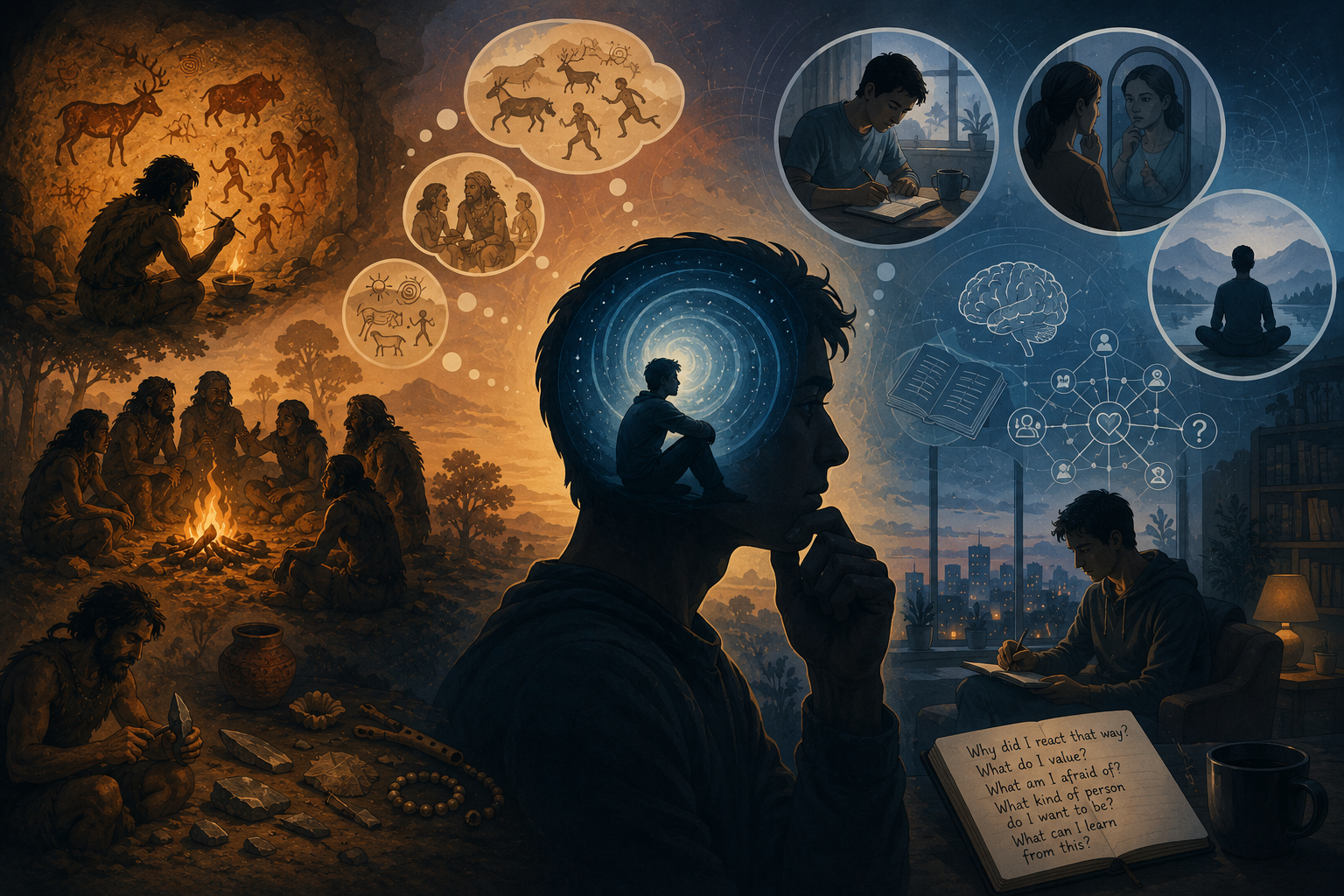
The Gift of Looking Within
A wolf senses danger and runs. A human relives the moment long after it has passed. Somewhere along the journey, we learned to look inward.
Listen to this story
A wolf senses danger and runs.
A deer hears a sudden sound and freezes.
A bird takes flight at the shadow of a predator.
Their reactions are swift, efficient, and often life-saving.
Now imagine a human.
The danger has passed.
The body is safe.
Yet the mind continues the conversation.
"Why did I react that way?"
"Was I right?"
"What could I have done differently?"
"What will happen if this happens again?"
Somewhere along our evolutionary journey, humans acquired an extraordinary ability.
We did not merely experience the world.
We began to experience ourselves experiencing it.
· · ·
Archaeological discoveries reveal more than stone tools and ancient fires.
They reveal symbolic art painted on cave walls, ornaments made from shells carried over long distances, carefully prepared burials, musical instruments carved from bone, and objects whose value cannot be explained by survival alone.
These discoveries suggest that humans were not only solving practical problems.
They were reflecting, imagining, remembering, and attaching meaning to their lives.
The mind had begun to look inward.
· · ·
Language played an important role in this transformation.
Long before writing existed, stories travelled from one generation to the next.
People spoke of successful hunts, dangerous animals, changing seasons, trusted friends, wise elders, and unexpected mistakes.
Knowledge was no longer stored only in experience.
It could be shared through words.
Eventually, those stories expanded.
Humans began talking not only about the world around them, but also about the world within them.
Joy.
Loss.
Hope.
Regret.
Fear.
Love.
The invisible life of the mind slowly became something that could be explored together.
· · ·
Anthropologists often point out that every known human culture has developed ways of helping people understand themselves.
Some cultures told stories.
Others composed poetry.
Some reflected through philosophy.
Others through rituals, meditation, or conversation with elders.
Although these traditions differ enormously across societies, they share a remarkable idea.
Human beings are capable of observing their own thoughts.
· · ·
Modern psychology gives this ability a name.
Metacognition.
Quite simply, it means thinking about our own thinking.
It is one of the defining characteristics of the human mind.
Imagine becoming angry.
One response is immediate.
Raise your voice.
Walk away.
Argue.
Remain silent.
But another possibility also exists.
To pause.
To notice.
To become curious.
"Why did that affect me so deeply?"
The anger may remain.
The situation may not change.
Yet something important has happened.
Attention has shifted.
Instead of looking only at the outside world, the mind has turned inward.
· · ·
This capacity may be one of humanity's greatest evolutionary advantages.
It allows us to learn from mistakes.
To reconsider decisions.
To question long-held beliefs.
To imagine different futures.
To understand other people's perspectives.
And perhaps most importantly...
To understand ourselves.
· · ·
None of this guarantees wisdom.
Human beings are capable of misunderstanding themselves just as easily as they misunderstand others.
We create stories that protect our egos.
We overlook our own biases.
We remember selectively.
Psychologists continue to study these tendencies, revealing how easily the mind can misinterpret its own experiences.
Looking inward is not the same as seeing clearly.
It is simply the beginning.
· · ·
Throughout this series, we have explored an ancient survival system shaped by millions of years of evolution.
We have seen how cooperation transformed our species.
How emotions often arise when the mind believes something important is under threat.
How modern life presents challenges our ancestors never encountered.
Now another possibility emerges.
Perhaps evolution gave us more than the ability to survive.
Perhaps it also gave us the ability to examine the very systems that help us survive.
That ability does not remove fear.
It does not erase anger.
It does not eliminate uncertainty.
But it gives us something profoundly human.
Perspective.
· · ·
Imagine noticing a powerful emotion and asking:
"What is my mind trying to protect?"
Sometimes the answer may be obvious.
Sometimes it may take days, months, or even years to understand.
Sometimes the answer may change as we grow.
The question itself is what matters.
Because every time we ask it, we become less occupied with judging ourselves...
and more interested in understanding ourselves.
Understanding is not the end of the journey.
It is the beginning of freedom.
Not freedom from emotion.
But freedom from believing that every emotion must immediately become action.
Between feeling and responding lies a uniquely human space.
Within that space lives reflection.
Curiosity.
Choice.
Evolution gave us a mind capable of protecting life.
Human civilization taught us to question that mind.
Science continues to help us understand it.
Perhaps one of the greatest expressions of courage is not the absence of fear—
but the willingness to look inward with honesty and curiosity, wherever that journey may lead.