
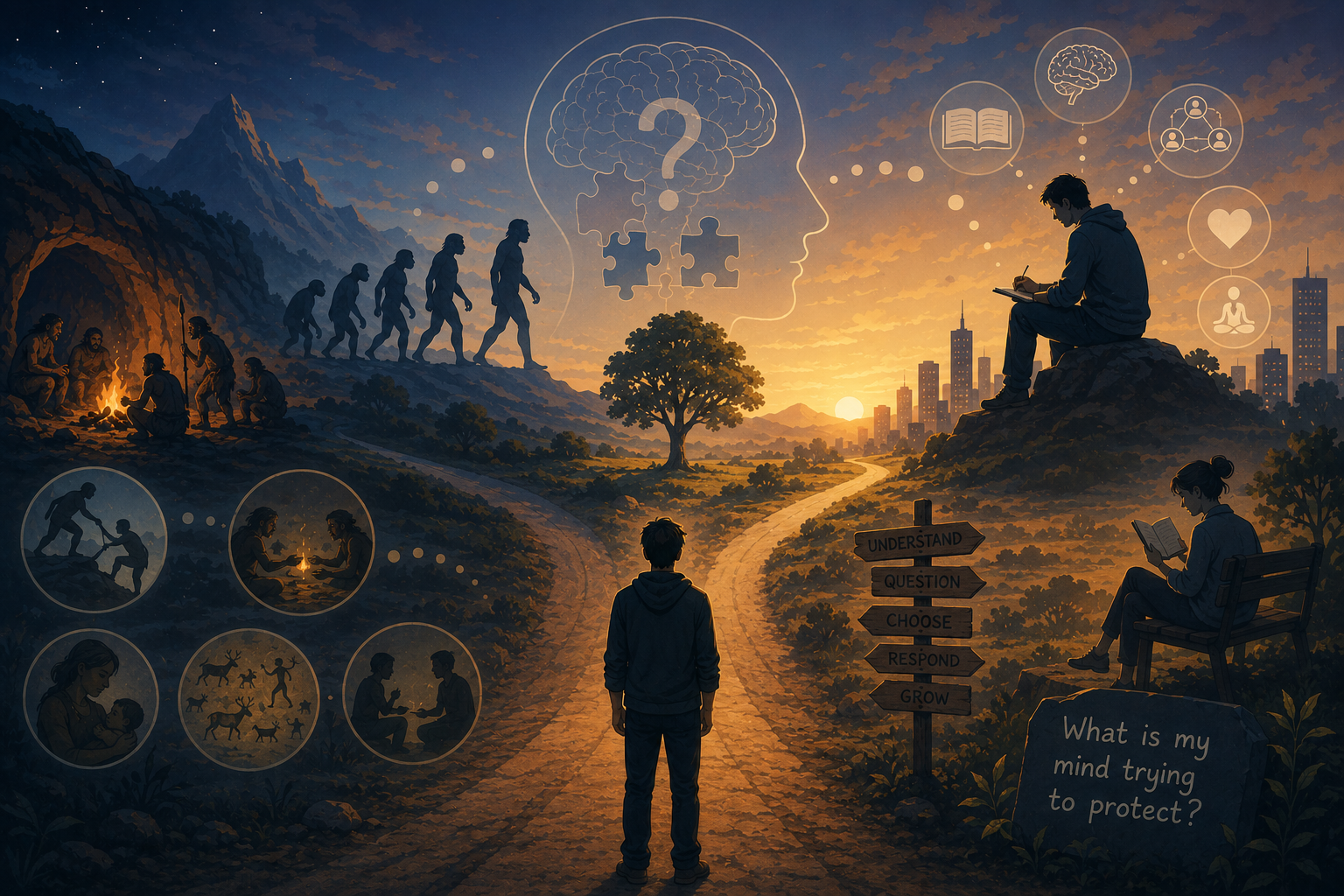
The Courage to Understand
The most dangerous predator our ancestors faced was not always the one hiding in the grass. Sometimes it was the one hiding in certainty.
Listen to this story
The most dangerous predator our ancestors faced was not always the one hiding in the grass.
Sometimes it was the one hiding in certainty.
To survive, the human mind had to make quick judgments.
"That sound could be dangerous."
"That stranger may not be trustworthy."
"That path looks unsafe."
Waiting too long to decide could carry enormous consequences.
Evolution did not reward perfect knowledge.
It rewarded decisions that improved the chances of survival.
Those decisions were often made with incomplete information.
· · ·
The remarkable success of our species did not come from always being right.
It came from being able to learn.
Every generation inherited more than genes.
It inherited stories.
Mistakes.
Discoveries.
Questions.
Fire was improved.
Tools became more refined.
Language became richer.
Knowledge accumulated because humans could look beyond immediate survival and ask,
"Could there be a better way?"
Perhaps that same question is one of the greatest gifts we have inherited.
· · ·
Throughout this series we have followed a long journey.
We began with a simple observation.
Life survives by protecting itself.
Over millions of years, evolution shaped nervous systems that became increasingly capable of detecting danger and responding to it.
Later, humans transformed survival into something shared.
Families.
Communities.
Friendships.
Trust.
Our minds gradually learned that protecting life also meant protecting relationships.
We then explored how many emotions may become more understandable when viewed through the lens of what the mind believes is at risk.
Not because every emotion has a single cause.
Not because evolution explains everything.
But because asking what is being protected often reveals more than asking what is being felt.
Finally, we saw that the modern world asks ancient minds to solve problems unlike any encountered by our ancestors.
The environments have changed.
The biological foundations remain.
· · ·
What, then, should we do with this understanding?
Science cannot answer that question for us.
It can explain how emotions arise.
It can identify patterns.
It can test hypotheses.
It can help us understand ourselves more clearly.
But it cannot tell us what kind of person we ought to become.
That choice belongs to every individual.
· · ·
Yet understanding itself changes something.
Imagine holding a map of an unfamiliar city.
The map does not shorten the journey.
It does not remove obstacles.
It does not decide which road you should take.
But it allows you to see where you are.
Understanding the mind works in much the same way.
It does not eliminate anger.
It does not erase jealousy.
It does not prevent anxiety.
It does not guarantee courage.
What it often provides is perspective.
And perspective quietly changes the relationship we have with our emotions.
· · ·
There is a profound difference between saying,
"I am an angry person."
and asking,
"What is my anger trying to protect?"
There is a difference between believing,
"Something is wrong with me."
and wondering,
"Why does my mind see this as a threat?"
The emotion may remain.
But curiosity has entered the conversation.
Curiosity rarely silences emotion immediately.
It does something more valuable.
It keeps understanding alive.
· · ·
For thousands of years, people across cultures have searched for ways to understand themselves.
Some turned to philosophy.
Others to stories.
Some reflected through prayer or meditation.
Others through conversation, art, or careful observation of life.
Today, neuroscience, psychology, anthropology, and evolutionary biology offer new ways of exploring many of the same questions.
Each approach is incomplete on its own.
Together, they remind us that the human mind is both ancient and continually evolving in its understanding of itself.
· · ·
Perhaps courage has never meant the absence of fear.
Perhaps courage begins much earlier.
The willingness to pause.
The willingness to question.
The willingness to admit,
"I do not yet understand why I feel this."
There is remarkable strength in that sentence.
Because understanding is not weakness.
It is exploration.
· · ·
Our ancestors survived because they learned about the world around them.
Modern humans have another opportunity.
To learn about the world within them.
Not to excuse harmful behaviour.
Not to justify every emotion.
But to understand where these experiences may come from, and to decide, with greater awareness, how we wish to respond.
Understanding is not endorsement.
It is the beginning of choice.
And choice may be one of the greatest expressions of being human.
Evolution gave us a mind that learned to protect life.
Human civilization taught us to examine that mind.
Science continues to reveal how remarkably it works.
Perhaps the greatest journey is no longer across continents or oceans—
but the quiet journey of understanding ourselves.
And every journey begins with a single question.
"What is my mind trying to protect?"