
Listen to this story
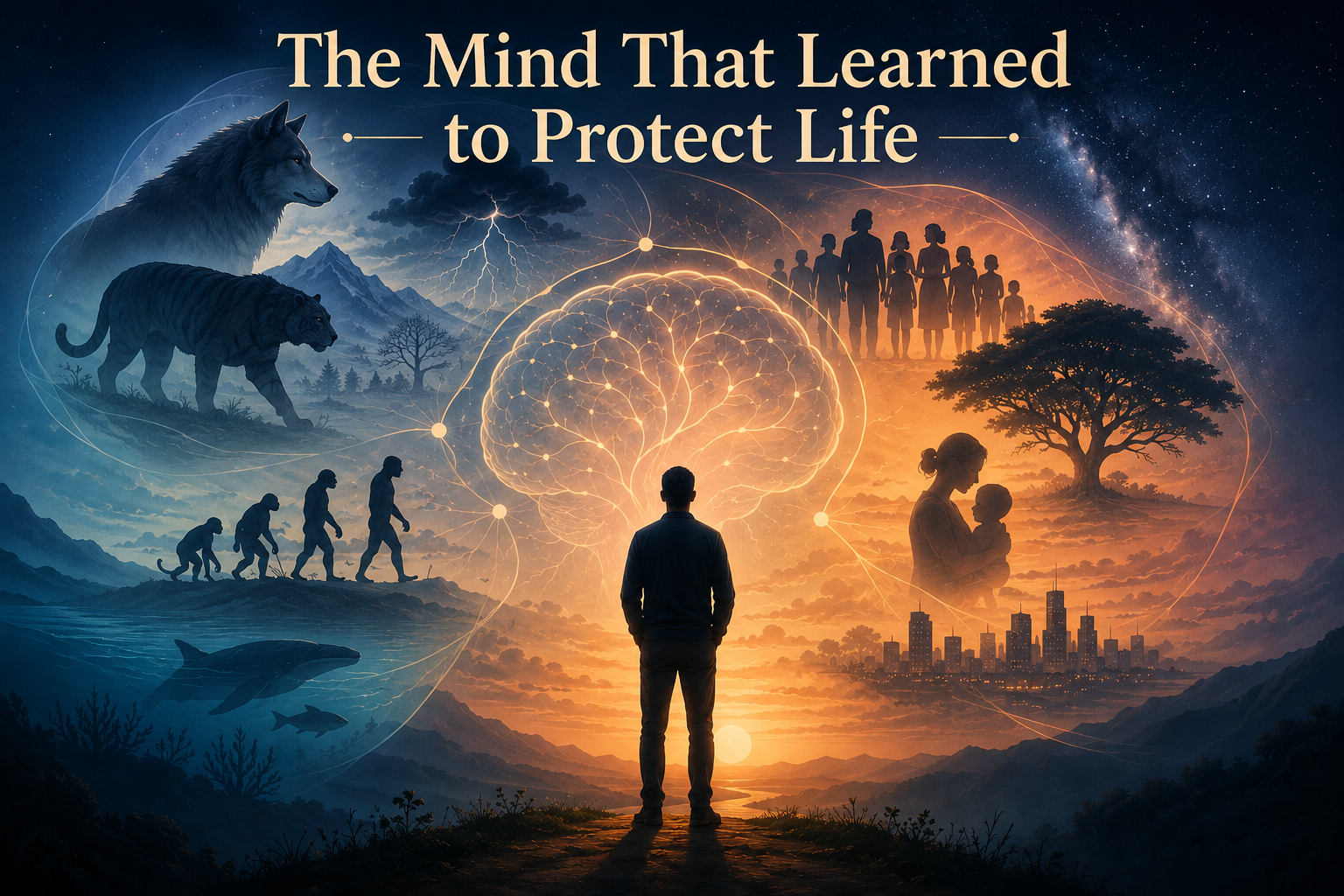
Long before there were cities, civilizations, or even humans, there was a simple challenge shared by every living thing.
Stay alive long enough to leave behind another generation.
Every plant reaching towards sunlight, every bird taking flight, every deer listening for the faintest rustle in the grass, every tiny creature hiding beneath a stone—each was solving the same problem. Life had only one way of continuing: it had to survive.
Those that failed disappeared.
Those that succeeded became the ancestors of everything living today.
Over countless millions of years, evolution did not plan, design, or foresee the future. It simply favored characteristics that improved the chances of survival and reproduction. Gradually, living organisms became better at sensing changes around them. They began distinguishing safety from danger, food from poison, friend from foe.
The earliest nervous systems were not built to understand the world.
They were built to respond to it.
As animals became more complex, so did their ability to detect threats. A sudden movement, an unfamiliar sound, the scent of a predator, a change in the weather—recognizing these signs even a moment earlier could mean the difference between life and death.
· · ·
Nature had an interesting problem to solve.
Imagine hearing a rustle in the bushes.
If you assumed it was only the wind but it turned out to be a predator, the mistake could be fatal.
If you assumed it was a predator but it was only the wind, you wasted a little energy and perhaps looked unnecessarily cautious.
Across evolutionary time, one kind of mistake was usually far more costly than the other.
Missing a genuine threat.
This simple imbalance gradually shaped nervous systems that often preferred caution over complacency. In many situations, responding to a possible danger was safer than ignoring one.
This does not mean living creatures became fearful of everything.
It means natural selection often favored systems that treated uncertain situations with appropriate vigilance when the cost of overlooking danger was high.
Humans inherited this ancient legacy.
· · ·
But by the time our ancestors appeared, survival had become far more complicated than escaping predators.
A human child depended on adults for many years. Families depended on one another. Groups shared food, protected one another, and passed knowledge across generations.
Survival was no longer only about sharp teeth and fast legs.
It was increasingly about cooperation, memory, communication, and relationships.
The mind had to protect more than the body.
It had to protect everything that made survival possible.
· · ·
This ancient survival system never asked a single question:
"Will this make me happy?"
Instead, it asked another:
"Could this place something important at risk?"
That "something important" changed as humans evolved.
Sometimes it was life itself.
Sometimes it was food.
Sometimes it was shelter.
Sometimes it was a child.
Sometimes it was the trust of the people around us.
As human societies grew more complex, the number of things worth protecting also grew. Yet the underlying purpose of the survival system remained remarkably similar.
It was always trying to preserve something valuable.
· · ·
Modern life often feels very different from the world of our ancestors. Most people no longer wake each morning wondering whether a predator is waiting outside. We have homes, medicine, agriculture, technology, and communities that solve many of the dangers our ancestors faced every day.
Yet the mind we carry into this modern world is not entirely modern.
It is the product of a very long evolutionary journey.
The remarkable abilities that define our species—language, imagination, planning, and self-reflection—were built upon much older biological foundations. The systems that helped our ancestors survive were not discarded as new abilities emerged. Instead, evolution layered newer capacities upon older ones.
Perhaps this explains something many people quietly experience.
Why can a harmless criticism linger in our thoughts?
Why can uncertainty keep us awake at night?
Why do some situations feel overwhelmingly important, even when no physical danger exists?
These questions do not necessarily have simple answers, and no single theory explains every human emotion. Psychology, neuroscience, anthropology, and evolutionary biology each offer pieces of a much larger puzzle.
But together they invite an intriguing possibility.
Many of the emotional struggles of modern life may become easier to understand if we first ask what our ancient survival systems believe they are protecting.
That question will guide every story in this series.
Not because evolution explains everything.
But because understanding where our minds came from may help us better understand how they work today.
· · ·
Perhaps the first step toward understanding ourselves is not to ask,
"Why do I feel this way?"
but rather,
"What might my mind be trying to protect?"
Our ancestors did not pass on a perfect mind.
They passed on a mind that was remarkably successful at keeping life going.
Understanding that difference may be the beginning of understanding ourselves.