
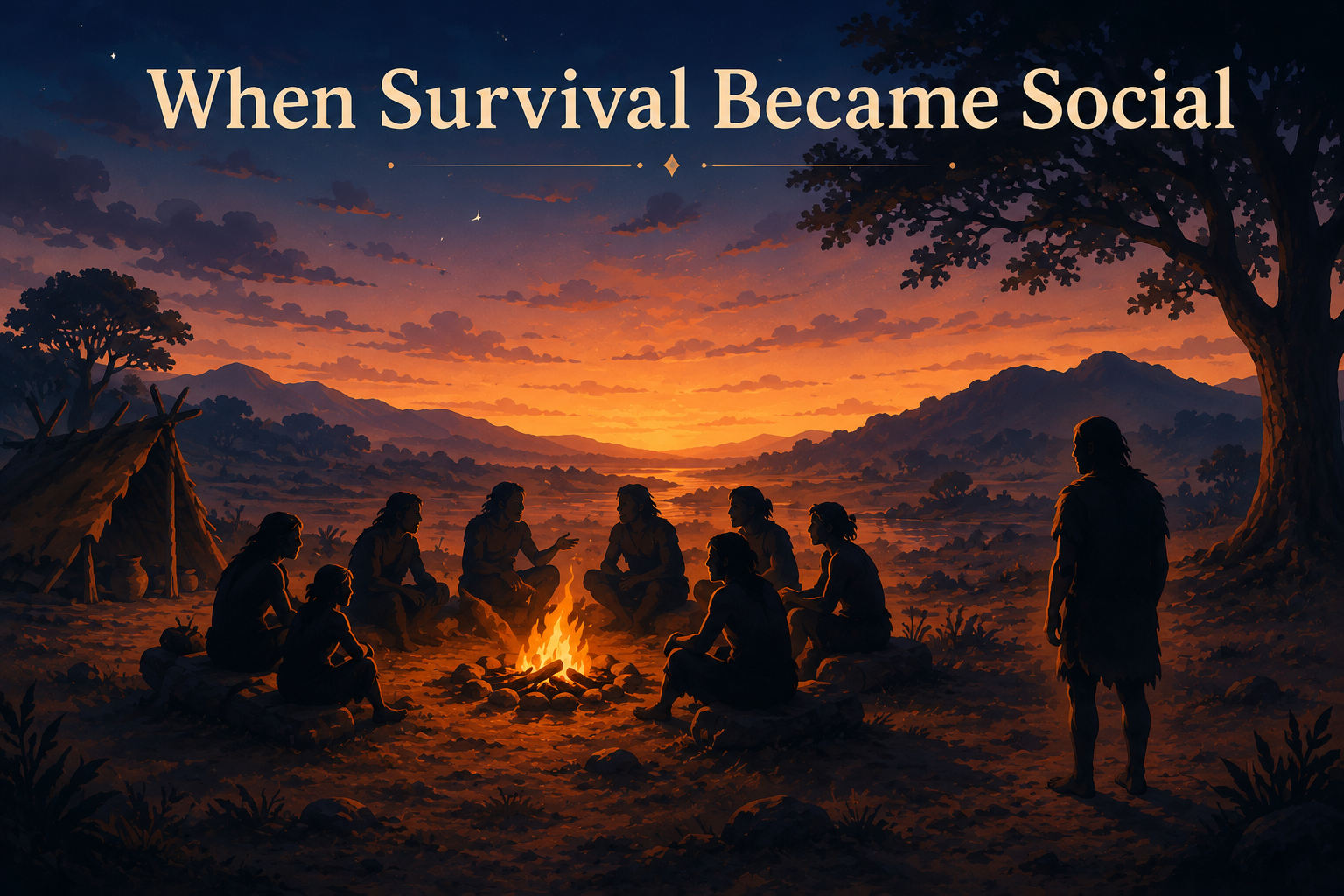
For most of the history of life, survival was a solitary affair. Then humans took a very different path.
Listen to this story
For most of the history of life, survival was a solitary affair.
A deer had to outrun a predator.
A bird had to find food before nightfall.
A tortoise carried its protection on its back.
Each organism relied primarily on its own abilities to stay alive.
Even among animals that lived in groups, cooperation was often simple and immediate—watching for predators, hunting together, or protecting offspring. The group increased the chances of survival, but each individual still depended largely on instinct and physical ability.
Humans would eventually take a very different path.
· · ·
Imagine standing on an open plain nearly two hundred thousand years ago.
You are not the fastest animal.
You are not the strongest.
You have no sharp claws or powerful jaws.
Night brings predators.
Winter brings hunger.
Injury can leave you unable to hunt.
A child cannot survive alone.
An elder carries knowledge but may no longer be able to run.
How does such a species survive?
Not by becoming stronger than nature.
But by becoming stronger together.
· · ·
This was one of evolution's greatest experiments.
Humans gradually became a species whose survival depended less on individual strength and more on cooperation.
Food was shared.
Children were cared for by parents, grandparents, relatives, and other members of the group.
Knowledge passed from one generation to the next.
Fire was watched through the night.
Someone kept watch while others slept.
A successful hunt was rarely the achievement of one person alone. It belonged to the group.
Anthropological studies of hunter-gatherer societies, together with archaeological evidence, suggest that cooperation was not an occasional advantage—it became one of the defining features of being human.
· · ·
Something remarkable happened as this way of life evolved.
The human brain was no longer protecting only the individual.
It was protecting relationships.
A trusted companion.
A caring parent.
A reliable hunting partner.
A respected elder.
A loyal friend.
These were no longer simply pleasant parts of life.
They became part of survival itself.
· · ·
Imagine losing the trust of your group.
Perhaps no one shares food with you.
Perhaps no one helps when you are injured.
Perhaps no one watches your children while you search for food.
In small communities, such losses could have serious consequences.
Being accepted was not merely about feeling included.
It often affected the ability to survive and raise the next generation.
This helps explain why humans seem unusually sensitive to acceptance, reputation, fairness, and belonging.
These concerns are not inventions of modern society.
Their roots may reach far back into our evolutionary history.
· · ·
Today, the dangers are different.
Most of us no longer depend on a small tribe for our next meal.
Yet our minds often respond to social situations with surprising intensity.
A harsh criticism can remain with us for days.
Being ignored may hurt more than expected.
Embarrassment can feel overwhelming.
Loneliness can become deeply painful.
Modern neuroscience has shown that social pain and physical pain involve some overlapping brain processes, although they are not identical experiences. Researchers continue to explore why social experiences can have such powerful effects on human well-being.
Evolutionary thinking offers one possible explanation.
For much of human history, maintaining social bonds was closely connected to survival.
The mind learned to treat certain social threats as important because, for countless generations, they often were.
This does not mean every uncomfortable social experience is an ancient survival alarm.
Human emotions are shaped by many influences—our personalities, childhood experiences, cultures, relationships, and present circumstances all matter.
Evolution provides one layer of understanding, not the entire story.
But it does remind us of something important.
The modern world may have changed far more rapidly than the human mind itself.
The tribe has become a classroom.
A workplace.
A neighborhood.
An online community.
The faces have changed.
The ancient need to belong remains.
Perhaps this is why rejection feels heavier than simple disagreement.
Why kindness can transform a stranger into a lifelong friend.
Why trust takes time to build but moments to lose.
Our social world is not simply an invention of civilization.
It is built upon foundations laid over hundreds of thousands of years of living, surviving, and growing together.
Long before humans built cities, they built relationships.
And perhaps one of evolution's greatest achievements was not creating a species that could survive alone—
but one that learned survival could be shared.